What makes me upset is that the economic realities do not match what is taught in large swaths of America. We are taught (at least in my community, and I am 30 now still living within 20 miles of where I grew up) that a very achievable ideal is a middle class existence with one parent working, and a small house in the suburbs. I am in the top 1% income earners for my generation and do not even come close to this.
I think it's important for young parents to start breaking this cliche that economic prosperity is an American standard. Instead we should be teaching that life is hard and you should count your lucky stars if you are able to afford anymore more than an apartment.
You must be exaggerating or living in New York/San Fran.
Here in the midwest is is very reasonable for a top 20% income for 30 yr old age bracket to have only one parent work. If you're top 1% you can definitely afford a house in the suburbs and have one parent stay home.
I guess it depends how you define "large swath". Is it a certain amount of landmass or population, a percent of total landmass or population, or some other metric? I think this line is needlessly pedantic. It's reasonable to interpret rubidium's comment as just meaning "the expensive housing in the NY and SF areas are too expensive to be feasible for top 20% earners, as the OP said, but by and large, a middle class existence is possible for most land in America." Population centers with expensive housing may be inaccessible for the regular middle class (when top 20% income earner means only 60k/year or so based on 2010 data[0]). This isn't really the right data to use, because the pay for people in SF is different than say, somewhere in Missouri. With that being said, it seems clear that the American dream of a middle-class existence with only one working adult, isn't realistic everywhere for everyone.
I might be meandering here, but I think this reasoning is actually flawed or biased, because it was never true to begin with. A factory worker could never afford to live in the upscale street, right? The only difference now is that instead of a factory worker not being able to live on the upscale street, there are whole neighborhoods, downtown areas, and maybe even suburbs that are unaffordable to a typical middle-class family.
I haven't looked for data to support these ideas, and am very open to points for and against.
I'm from Indiana - and that is exactly the problem. Sure, housing is affordable. But wages are a fair amount lower and a fair amount of jobs are low-paying. This is really a major problem with people looking at economic recovery - wages haven't caught up for a fair amount of folks. That all said, it might actually be easier to get to that 'dream' if you plan correctly and are willing to let a few things go: Alternatively, for some it might not be a choice because of the costs of childcare and transportation.
I live about 30-40 miles outside of D.C. The only people I know who have a house earn significantly more, or are dual income top-tier earning households.
The tech sector is this nice bubble where we've seen lots of economic prosperity. If you look at the statistics you'll see that's not the case for a large swath of America.
One thing to consider is that a growing portion of Americans (perhaps a majority, soon) do not want the small house in the suburbs with a white picket fence, 2.33 kids, a stay at home mom, and a 50 minute commute that the baby boomers' parents wanted. People are starting to remember that the reason we created cities is that city living is desirable, and they are willing to pay a premium for that.
Life is not hard for the rentiers extracting labour for your right to exist in said apartment.
Where is all your labour going? Food? No. Transport? No. Energy? No. Rent? Bingo.
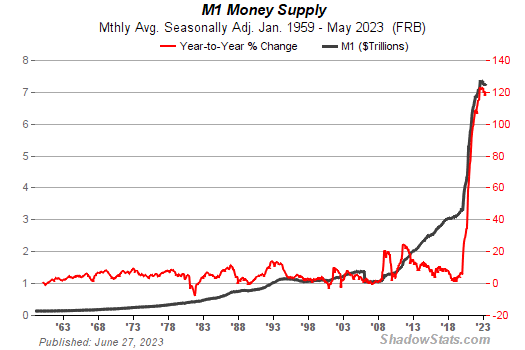
Why is this happening? Because we came off the gold standard and there is no limit to the expansion of fiat money, therefore it expands via mortgage lending to mop up all productivity gains. Get the women out to work! Land prices up. Efficiency gains? Land prices up.
We bid for land. The more we have available after basic living costs the more we can pass over to the rentiers.
We need land value tax to suppress rentier activity.
Gold standard has nothing to do with it. What money is, at a fundamental level, is a promise you can later redeem for real goods and services. Why there's so much mortgage and student loan debt follows directly from the demographic changes - the retiring generation needs promises to provide real goods and services (both directly through saving, and indirectly through pensions and the like), so capital markets seek out the best opportunities to extract these promises and provide them.
By creating credit faster than the underlying wealth creation of an economy banks are appropriating real goods and services and the wealth generation later (or rather now as they lent for decades like this) and they walk off with the goods whilst we all drown in asset inflation.
I would agree that demographics played a big part. Boomers borrowed heavily as though the demogrpahic inversion were not a problem, and banks played along. Now we have the money supply collapse as we have more olds than young, meaning a collapse in credit supply which is a problem as the model requires that principal + interest is paid back which cannot happen unless more debit is issued into the face of loan expiry which destroys the credit but still requires the interest be paid from some other debt source.
Why else do we need constant QE and ZIRP? To encourage more borrowing to try and maintain the rate of credit creation to keep the money supply up as boomers pay down at their end of life.
What a nuts system and also a terrible one as all productivity gains are soaked up by adaptable pricing on land to capture all gains.
excited for my HN "you're submitting too fast" soon when anything about banks or rentiers is mentioned!
Credit is money - there's literally no distinction between the two. Precious metal currencies are only money because it takes way less systemic trust to believe that the bearer of precious metal coins can get things for them later. Gold-backed paper currencies are an interesting intermediate, basically adding trust that you can exchange them for the actual metal at banks.
> While money is essential to facilitating purchases and sales of real resources outside the banking system, it is not itself a physical resource, and can be created at near zero cost.
> The fact that banks technically face no limits to instantaneously increasing the stocks of loans and deposits does not, of course, mean that they do not face other limits to doing so. But the most important limit, especially during the boom periods of financial cycles when all banks simultaneously decide to lend more, is their own assessment of the implications of new lending for their profitability and solvency. By contrast, and contrary to the deposit multiplier view of banking, the availability of central bank reserves does not constitute a limit to lending and deposit creation. This, again, has been repeatedly stated in publications of the world’s leading central banks.
The current model of understanding is broken. To issue money nothing has to be created, therefore if one issues money whilst wealth creation stands still one appropriates some of the total wealth through inflation.
Before if you wanted more money you had to have more gold reserves, or the govt/central bank had to lower the exchange rate.
Because new production of gold would add only a small fraction to the accumulated stock, and because the authorities guaranteed free convertibility of gold into nongold money, the gold standard ensured that the money supply, and hence the price level, would not vary much.
> the availability of central bank reserves does not constitute a limit to lending and deposit creation
Private banks decide how much land costs. And they always lend as much as they can, so land will always be as much as people can possibly pay. This means that no amount of efficiency gains will ever improve life. All you will see is inflation and people who bought just before the jump have a gain, but again the next batch are pushed into servitude. Because we haven't had a big step-change in efficiency for a couple of decades (and in part because it's not passed on due to globalisation / migration) it's misery all round, unless you are a usurer.
Of course a gold standard would limit the creation of money, but the ability of banks to increase the money supply would still exist under fractional-reserve banking.
A lot of us landlords barely cover the mortgage with how much we can charge in rent. We don't simply get to increase prices and expect tenants to keep paying.
But at the end of it you get a free house for hardly any labour. Yes you have to do a bit now and again but it's hardly a full time job that your tenants have to do to cover your mortgage.
I never understand why you guys are doing it if you don't gain. You are doing it because it is easy money, an easy way to extract labour.
What are you expecting anyway in terms of an ongoing income stream from this endeavor? It's very low skill, to borrow you need a pulse and a job. To administer you need basic numeracy. Hardly any labour required, certainly not skilled. Sounds like minimum wage for the basic admin required, so what, a few hours a month?
The only "value" here is the ability to borrow to exert monopoly control over other wage earners in order to force them to give you a portion of their labour. That is the main ingredient in the majority of cases. Yes we need a rental sector but as I said it's low skill and the rewards should reflect this instead of dividing society into have and have-nots.
The rewards roughly do reflect this. Ordinary investing isn't clearly better or worse than investing in property. The problem is that ordinary investing requires many years of self discipline while paying a mortgage has the bank holding a stick over you to keep you from wasting your income on lattes and holidays.
You know, you could actually study why the gold standard is a terrible idea, rather than just fantasizing about it.
The financial trickery you're talking about is caused by deregulation and would happen on the gold standard just as often, but with probably far more disastrous consequences.
I don't like the gold standard, I agree there. I do however think it provided some break on the unfettered issuance of fiat credit.
In any case it seems you agree that unfettered credit issuance is a huge problem, and perhaps the root cause of the upward pressure on asset prices that inevitably moves in step with productivity gains / more work?
I am 40, and it was a nostalgic conservative thing among my parents' generation. For my parents and their fundamentalist subculture, it was almost a religious obligation, tied up in ideas about gender roles.
I'm more than a decade younger than you and grew up in a single income family, lots of children, solidly middle class, and neither of my parents had beyond a high school education. My dad was a straight C student through school and neither of my parents could help me with my math homework by the time I was in junior high...so hard working people, but not book smart by any means.
Lots and lots of my school mates families were similar.
Northwestern Pennsylvania. Rust belt, Great Lakes region.
Anecdotally, more than half of my peers had both parents working. My mother and both grandmothers had jobs. The attitude was that two incomes are better than one in an age of economic uncertainty - an era that kicked in no later than the 70s.


I think it's important for young parents to start breaking this cliche that economic prosperity is an American standard. Instead we should be teaching that life is hard and you should count your lucky stars if you are able to afford anymore more than an apartment.