I have photovoltaics on my roof. I won't be doing it again.
I'm almost certain that putting the money that they cost into making my home more efficient in the first place, by doing things like sealing leaks, upgrading the insulation, and, yes, making the roof a lighter color, would have reduced our energy consumption by more than the amount that the PVs are generating.
The PVs absorb a lot of thermal energy, too, more than the shingles themselves do. So they make the roof hot. You can actually feel the difference inside the house - the rooms that are underneath the solar panels get warmer in the summer than the ones that aren't. So some amount of that electricity we're generating would seem to just be undoing the effects of the PVs on the house's thermal situation. There's still a net benefit, but probably because we're people who are inclined to accept that summer is hot in the first place. Trying to keep those rooms at or below 80F/26C might be an expensive endeavor.
Also, I've discovered that one does not simply have a roof leak fixed when there are solar panels on the roof, because they are in the way. So maintenance has been rather more expensive than I expected.
In general, I'm sanguine about solar as a renewable option. I'm just increasingly inclined to believe it's better implemented as an industrial technology, and that homeowners probably have better options for greening their houses.
Interesting. My PVs have made the house substantially cooler. There is an air gap between the panels and the roof itself - they effectively shade the roof.
Same. This statement is bizarre to me. You can’t bolt solar panels directly to a roof. There is an air gap from the rails and also the edges of the panels.
Are you in a mobile home or something?? I have solar too and I absolutely love it. I’m not sure how anyone could feel warmer in a room with panels above as i’ve never seen a stick house without attic spaces and i’ve used my IR camera to look for hot spots and i see nothing out of the normal where any panels are… also, panels tend to cover the entire surface area where the sun is shining the most too not just rooms so it makes no sense to me read what you’re saying.
To make solar worthwhile we did an energy audit so we also replaced windows, got new siding and installed new doors. Energy efficiency doesn’t have to be mutually exclusive. I got a bigger rebate from the city with proof of energy audit.
as far as roof repairs… why would solar matter and why so many roof repairs? I’ve been through tropical storms, down pours and many a hail storm and not a single problem and my roof is 23 years old..
I could never go back. I charge my Tesla at home and my electric bill averages about 70 a month over a year after solar. That’s less than a weeks worth of gas for my Jeep.
year 6 on panels and 0 maintenance with a 20 year guarantee on efficiency and install warranty if i had problems i’d call my installer for service.
>> The PVs absorb a lot of thermal energy, too, more than the shingles themselves do. So they make the roof hot. You can actually feel the difference inside the house - the rooms that are underneath the solar panels get warmer in the summer than the ones that aren't.
I've actually read the opposite: most PVs don't sit directly on the roof, but rather a few inches above it. And that air gap further limits the amount of solar energy that makes it onto the roof and into the attic.
That claim doesn't really add up. I have solar panels as well and yes - not only is their an air gap, but pretty obviously the rooms they're over are north facing (I'm in Australia) with north facing windows and obviously get hotter anyway due to that.
I came across a forum thread for Baja California, where thay have and discuss off-grid air conditioning in a very hot area of Mexico. Interesting discussion.
> The PVs absorb a lot of thermal energy, too, more than the shingles themselves do.
I've found this to be interesting going back as far as middle school, where we're taught renewable energy sources like solar panels can help reduce global warming by replacing greenhouse gas emitting alternatives. Yet fundamentally, they are designed to turn the only external source of energy our planet receives (sun light) into heat and other forms of energy that will eventually become heat rather than reflecting it back out into space (albeit through the atmosphere). Seems so backwards to me.
The problem we're trying, broadly, to solve right now isn't "we're directly heating up the planet" but "we're trying to stop trapping heat in the atmosphere through a potentially self-propagating greenhouse process".
This is why carbon neutrality is the focus and not just purely energy usage.
A better argument for solar panels is that per kwh of useful energy, a solar panel traps less solar energy (in kwh) than the CO2 produced by coal or gas or w/e. But I've never see this particular argument made and therefore couldn't even guess at HOW much better a solar panel is than coal and HOW much worse it is than nuclear or geothermal (which could actually be net energy loss for earth, by dispersing some thermal energy locked deep within the earth out to space).
> A better argument for solar panels is that per kwh of useful energy, a solar panel traps less solar energy (in kwh) than the CO2 produced by coal or gas or w/e.
It's not a better argument because the solar panel doesn't "trap" the energy. At most it borrows it, eventually it will radiate back out if allowed to do so, just as it would if it were absorbed by a rock. Humans do not occupy enough of the surface of this planet to make a dent in that.
The thing that will keep it from radiating back out is greenhouse gases in the atmosphere. And unlike some brief capture of energy, the greenhouse cycle is essentially a chain reaction.
But it is radiating it 'back out' less efficiently than a white roof. Thus black solar panels may indeed be a net negative if every building otherwise would have had a white roof.
In a land of mostly dark roofs it's probably a net positive.
Unless you pump the energy deep in to the ground it will still eventually find its way to radiate back out in the form of infrared blackbody radiation. The timescale we're talking about isn't very long in the grand scheme of things, and the entire surface of the planet is doing this to some extent or another.
Even if we did one of those megasolar projects people like to talk about like paneling the whole Sahara or Mojave, we would still only be absorbing a tiny amount of the petawatts per second the sun is constantly bombarding the planet with, much of it being absorbed by plants, the ocean, darker rocks, etc.
Our solar panels just don't hit the scale that the melting ice caps do, and the only thing we can do to stop that is reduce the flow of new ghgs into the atmosphere.
That doesn’t follow. Consider the alternatives - thermal generation (including nuclear) must reject massive amounts of waste heat into the atmosphere, before the electricity is used and heat is generated from that use. That’s what cooling towers are designed to do.
That’s even before thinking about the effect from CO₂ or methane from gas fugitive emissions.
The earth has the ability to radiate away quite considerable amounts of heat luckily, and solar produces considerably less waste heat than thermal. So solar and wind can only make things better.
Minimising waste heat is of course good, which is why energy efficiency is so important, and heat pumps are doubly so - because they are extremely efficient, but also because they don’t produce as much heat but transfer most of it!
Yeah, it’s a little counterintuitive, I’d just keep in mind that the amount of energy we use is tiny compared to the amount that the sun bombards the earth with. The absorption and generation is going to be insignificant compared to the amount trapped by the addutional greenhouse gasses.
That’s not correct - nuclear power plants only have efficiencies of about 33-37%, so 63 to 67% of the energy that nuclear reaction is producing is dumped into the atmosphere which wouldn’t have otherwise (obviously there would have otherwise still been some radioactive decay of the material in the ground if it wasn’t used as nuclear fuel, but nothing like refining it and bringing it to a critical mass in a reactor).
Meanwhile, 100% of the energy that a solar panel receives (and radiates some back as heat) would have hit the earth anyway.
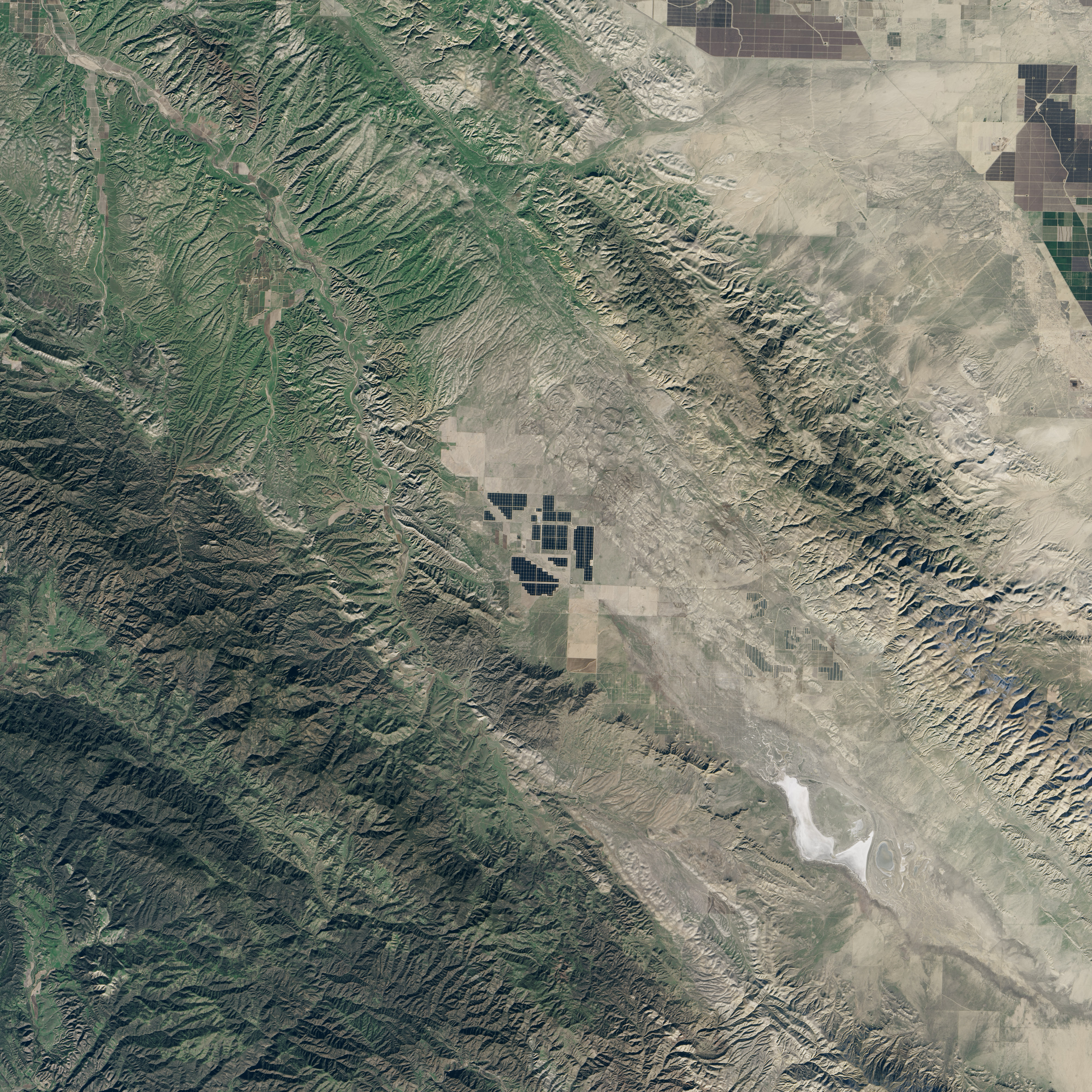
More of it is reflect back into space from many natural surfaces than from solar panels. Not scientific but look how black this solar farm appears compared to the surrounding land
It's mainly the visible wavelengths that can get through the atmosphere. You should see the absorption spectrum for water, it's remarkably transparent in the visible! That's how the greenhouse effect works - longer wavelength thermal radiation is blocked by greenhouse gasses.
It also heats up dark surfaces. One way to remove that heat would be to have some kind of combined PV + solar thermal panel. The other lower tech option is to cover your roof with soil and plants, which release the heat back during the night. Vegetation is esentially a heat buffer.
Right and so to follow this logic through, how do you think we get energy out of fossil fuels? Or nuclear reactors? Or a hypothetical fusion power plant?
> they are designed to turn the only external source of energy our planet receives (sun light) into heat and other forms of energy that will eventually become heat
How does a steam turbine work? By heat: we burn things to get heat, and use steam to turn it into work which..turns it into heat.
Your own statement is arguing against using energy in the first place, yet trying to frame it as a "renewable energy" problem as though the 60% of energy in gasoline isn't being thrown off into the environment, and 30-50% of energy in coal isn't the same, or as if literally every last bit of that - all of it because of the laws of thermodynamics - isn't eventually turned into heat.
Total estimate energy consumption per year [1] is about 14420 TWh as of 2021. The total solar energy we would've received in that same year [2] is 1,515,480,000 TWh. Or 0.00095%.
The amount of thermal emission from human activity on Earth is negligible. The idea that the amount of solar panels to power human civilization would have any non-local effect on the temperature of the planet is absurd.
I wasn't arguing against the use of solar panels, just pointing out that they don't reflect light as much as the natural environment that would have been in their place. This whole discussion is purely academic because the proportion of earth covered by solar panels is negligible.


I'm almost certain that putting the money that they cost into making my home more efficient in the first place, by doing things like sealing leaks, upgrading the insulation, and, yes, making the roof a lighter color, would have reduced our energy consumption by more than the amount that the PVs are generating.
The PVs absorb a lot of thermal energy, too, more than the shingles themselves do. So they make the roof hot. You can actually feel the difference inside the house - the rooms that are underneath the solar panels get warmer in the summer than the ones that aren't. So some amount of that electricity we're generating would seem to just be undoing the effects of the PVs on the house's thermal situation. There's still a net benefit, but probably because we're people who are inclined to accept that summer is hot in the first place. Trying to keep those rooms at or below 80F/26C might be an expensive endeavor.
Also, I've discovered that one does not simply have a roof leak fixed when there are solar panels on the roof, because they are in the way. So maintenance has been rather more expensive than I expected.
In general, I'm sanguine about solar as a renewable option. I'm just increasingly inclined to believe it's better implemented as an industrial technology, and that homeowners probably have better options for greening their houses.