>> it would imply the standard of living is increasing.
In USA, GDP includes the explosion of numbers of hospital admin staffers, energy prices doubled, and production of munitions which are given to Europe. That GDP does not increase my quality of life.
This reminds me of an old "ad" (not sure it was ever placed anywhere) questioning a similar tendency [1]:
> For years, economists have defined the economic health of a country by its gross domestic product. Trouble is, every time a forest falls, the GDP goes up. With every oil spill, the GDP goes up. Every time a cancer patient is diagnosed, the GDP goes up. Is this how we measure economic progress? Economists must learn to subtract.
"Every gun that is made, every warship launched, every rocket fired signifies, in the final sense, a theft from those who hunger and are not fed, those who are cold and are not clothed.
This world in arms is not spending money alone. It is spending the sweat of its laborers, the genius of its scientists, the hopes of its children. The cost of one modern heavy bomber is this: a modern brick school in more than 30 cities. It is two electric power plants, each serving a town of 60,000 population. It is two fine, fully equipped hospitals. It is some fifty miles of concrete pavement. We pay for a single fighter with a half-million bushels of wheat. We pay for a single destroyer with new homes that could have housed more than 8,000 people.... This is not a way of life at all, in any true sense. Under the cloud of threatening war, it is humanity hanging from a cross of iron."
(Aside: I have mixed feelings about this antiwar line of argument in 2023, because while it seems generally good to be antiwar, it also seems like these arguments come mostly from Russian-aligned forces. To whom my answer would have to be something like -- "yes, let us be anti-war. You first."
But that, while possibly more important than what I'm about to say, is not what I really did want to say. Which is --)
Eisenhower uses a phrase of considerable rhetorical power here --
> those who hunger and are not fed, those who are cold and are not clothed.
-- because he is essentially quoting the Beatitudes, and anyone who is familiar with them will fill in the rest.
Slightly less powerful to me (because it seems to equally reference William Jennings Bryan), but still very strong is
> humanity hanging from a cross of iron.
which is again extremely Christian imagery.
I'm not sure these phrases resonate so strongly with people today, but in those days they went straight to the heart of the question: What is it that is good?
I also really like the sentence,
> This is not a way of life at all, in any true sense.
because it focuses on the dichotomy of life vs. death, which again I think is very important. One could go in very positive green directions also from here. Some adjacent words would be: flourishing, abundant, fertile, growing. Frankly pagan things.
And, things that our economic metrics again tend to discount.
With all due respect to Eisenhower, this is an example of incredible political myopia. A country does not exist in a political vacuum and has to be able to protect its freedom and the very right to exist. So freedom is not free but comes at a price. How high the price is depends on the situation. Sometimes it's very high, unfortunately.
Complaining about this fact is as productive as complainig about gravity: if only we could float around effortlessly, imagine how much we would save on bridges and roads and fuel!
> A country does not exist in a political vacuum and has to be able to protect its freedom and the very right to exist
Do you think that Eisenhower, a professional soldier and 5 star general, doesn't understand that? You're not understanding / misrepresenting what he is saying in that quote. It's about the cost of a military and how it has to be balanced against the productive and social needs of a country. A country that is grossly over-spending on the military, as Eisenhower perceived it already back then, and particularly in the case of the US, when that military is used for force and power projection, not defence, is strangling the society that it pretends to protect. This has been the history of the US over at least the last 50 years (when Eisenhower made this fore-warning speech).
It's not a fact that the US needs to spend 50% of the global military budget. If anything is myopic, that is.
It can still be argued that it's worth the expenditure. But the cost should be weighted against the alternatives. Neither Russia or China can be said to threaten the US with their military, except with nuclear weapons, but no defence budget protects against those.
I'm saying that China was extremely prosperous and growing from 1980 to the present day, without increasing the size of its army 10x-20x-or-however-much-they're-increasing-it right now.
They don't have a real need for a bigger army, they could for sure defend themselves against any neighbor, even India and Russia, with "just" the military from 20 years ago.
If there was a total war scenario with Russia and China, all bets would be off regarding U.S. military budget, as they would most certainly be a dire threat to numerous allies of the U.S.
In practice, nothing (against multiple multi-warhead ICBMs). If your foe only has one or two ICBMs maybe you have even odds. Against any nuclear-armed nation other than present-day North Korea, nothing. Even if you could intercept 90% of missiles/warheads if the opponent fires 20 (or 2000), you're screwed.
There are multiple stages of flight in which one can attempt interception, but only the final stage after separation of warheads is realistic (which multiples the number of projectiles to intercept greatly): you can't intercept at accent unless you're very close to the launch site, hitting stuff in space with directed energy is defeated by a simple mirror, and hitting it with an inceptor is not feasible.
Tools created will be used, the cost of the US and Russian war arsenal is far greater than just the monetary cost to build them. One could argue that a weapons destructive force should be counted against it.
To strive for peace is not near sighted, it is the only way forward.
The world’s more peaceful during the era of American Hegemony than it’s ever been. Odd how having a gigantic military with hundreds of millions of people under it’s umbrella seems to have stemmed regional conflicts from erupting.
You can’t prove that regional conflicts would erupt should the US become more isolationist but any history book should quickly show you human’s propensity for war.
It also turns out that human’s tend not to outright attack foes that will immediately decimate them.
The USAF is the greatest stabilizer this world has as far as I can tell, missteps and outright awful moves like Iraq taken into account in this calculation.
It really does not matter, because my point is that weapons cost is a lot more than the fiscal cost of the weapon, it does not matter who bought the guns.
Both the US and Russia have used their weapons to decimate other economies. It is very hard for us to prove or disprove your point.
This is true, but it is also true that USA is perhaps the most geopolitically-secure state in world history and should be spending among the least on national security (per capita).
Americans don't even know what genuine "national defense" feels like. Instead, we have a world-class propaganda complex dedicated to rationalizing our unnecessary overseas military adventures and proxy wars.
The idea that blowing up a government or tribe in Africa or Asia to open up resource extraction (natural or financial) for a Western MNC will benefit the "freedom" of the average American is totally absurd.
> USA is perhaps the most geopolitically-secure state in world history and should be spending among the least on national security (per capita).
I think it glosses over too much complexity to simply state that, because part (not all! Geography is the other part) of the reason why we are so secure is that people know that we have that strong military. If the US were known as a soft target, who had neither the will nor the means to defend itself, we would probably see other actors much more willing to do things to us, such as piracy, etc.
The way to look at it is these are the tradeoffs, so we understand the ramifications. Do we need defense? Sure. But every $ we spend on it should be spent wisely, understanding that tradeoff.
We spend far more than we need to, and Eisenhower is 100% correct in the things we are giving up when we overspend on military.
> With all due respect to Eisenhower, this is an example of incredible political myopia.
I'm curious what you know about Eisenhower and his career — it's hard to imagine anyone in the past century whose background and experience made him less myopic than he.
More specifically, some valuable types of activities are not even measured in GDP - if you build your own table out of roadside scrap, then you might be immensely satisfied by the table, but it will contribute $0 to GDP. If you follow free instructions online (and look various stuff up on Wikipedia), that will again improve your life but not GDP.
The big thing is childcare from stay at home parents. That counts as 0 GDP, but put them in daycare and give the parent a job that's a net loss financially to the family and GDP has grown considerably.
I wonder how that kind of reclamation project could be valued in terms of avoidance of waste, avoidance of expenditure of new resources, and the skill development of the person doing the work (in terms of either/both faster pace of the same value created in future reclamations, and/or future marketability of the skills towards a saleable product).
You could start by valuing it at the price someone would pay for it, plus the price the worker would have paid for that many hours of hands-on education.
This isn't totally farfetched: in some countries if you own your house you pay tax on the rent you would have paid to yourself [0]. Taxing someone for feeding or educating himself seems like a small and natural next step.
> cancer patient is diagnosed, the GDP goes up. Is this how we measure economic progress?
Yes, obviously so! Diagnosing cancer early is one of the best ways to save someone from it. The cancer is there anyway, it's a natural occurrence. The economic activity that leads to and follows a cancer diagnosis is what economists call wealth: the things we do for each other than make each side mutually better off.
All the examples are like that. Nobody wants oil to spill, but accidents are a fact of life. The GDP created by mopping it up on the other hand leads to a cleaner environment, which is another form of wealth.
I think it was more that the harm caused in these (presumably) avoidable examples is not counted negatively. Preventing cancer makes less GDP than curing it; smoothly transporting oil without incident makes less GDP than spilling it.
Why does preventing cancer make less GDP than curing it? That would surely depend on how you're trying to prevent cancer. By prevent do you mean keeping a cancer somewhat under control?
> smoothly transporting oil without incident makes less GDP than spilling it.
Oil creates huge economic activity when used. It does no good spread over the ocean. The cleanup generates activity, but it's clearly far better for GDP to smoothly transport oil around than constantly lose it, if only because ships constantly sinking would cause people to transport things way less and so markets would be less efficient, yielding less wealth.
That's exactly what the PPP adjustment is supposed to capture. If a dollar buys half as much energy in the U.S. as the USD/EUR conversion does in Europe, that adjusts the EU PPP for the energy sector up by 2x. (Not exactly a great example, Europe has its own energy crisis.)
I'm surprised at the number of people who are confidently arguing against mrb - they're exactly correct here. The point of PPP adjustments is to factor out the effect of having a strong currency, and the USD's status as reserve currency is exactly why the US GDP has been overtaking the EU. Adjust for what a dollar actually buys you domestically and the picture is far more muddled.
> status as reserve currency is exactly why the US GDP has been overtaking the EU
USD was the reserve currency in the 90s and mid 2000s. Back then the Euro was very strong and some large European countries were close to overtaking US in GDP per capita.
The last 10 years have more or less been a lost decade in most of Western Europe because (amongst other things) it almost entirely missed out on the tech boom.
I agree. As I said in my first post: "prices of goods [eg. healthcare] are inflated in the US compared to similar goods in the EU". So concretely, if healthcare prices increase in the US, but remain constant in the EU, this would increase the PPP GDP of the EU.
What I meant to write is: if the PPP GDP increases in the EU faster than in the US, with all else being equal (eg. stable population) it would imply the standard of living is increasing faster in the EU than in the US.
GDP PPP in the US is identical to the nominal GDP in the US since the purchasing currency in the US is the US dollar.
> What I meant to write is: if the PPP GDP increases in the EU faster than in the US, with all else being equal (eg. stable population) it would imply the standard of living is increasing faster in the EU than in the US.
No it doesn’t mean anything of the sort in fact high nominal GDP to GDP PPP ratio usually indicates a low standard of living and a developing economy the Eurozone is an anomaly in this regard mainly due to its developed infrastructure and social institutions.
And don’t forget that your GDP PPP can be twice that another county whilst your median income is can be 10 times lower.
Median income per capita adjusted for PPP would be a better albeit an imperfect measurement of it since the standard of living is dependent on so many other things.
In which case there are only 4 countries which have higher median income PPP than the US, UAE, Luxembourg, Switzerland and Norway.
AIC/household final consumption expenditure is another good indicator for standard of living and wealth in which case the US is #1.
US economic performance is all the more OP if you take into account that it's a huge country of 350m people and has a diversified economic base.
For a tiny banking nation or petrostate to be rich is unsurprising.
But when it's half a continent, the world really ought to take out their notebooks and go into full copycat mode - at least as far as economic policy and attitudes are concerned.
Unfortunately, we are not allowed to print the world reserve currency like there is no tomorrow, and we do not possess the qualities of the US that make them the natural haven for capital in times of global turbulence.
That being said, the policy of austerity implemented during the Euro crisis was pretty catastrophic and arrested growth prospects for a whole generation.
>That being said, the policy of austerity implemented during the Euro crisis was pretty catastrophic and arrested growth prospects for a whole generation.
It was an austerity policy in name only given government debts have only continued to increase since then. There's a demonstrated correlation between high government debt and lower growth.
Nah, that’s demonstratively wrong dogmatism. Obviously it’s not a good idea to take three times your national GDP in debt to build three oversized airports next to each other because your family owns your nations construction business. But letting education and infrastructure collapse and watch a whole generation grow old without any chance meaningful workforce participation and without a chance at having a family is pretty devastating too.
This tendency didn't start at all with the Euro crisis. Remember Thatcher? She put this economic model firmly in place and everybody started to copy it, fiddle with it, without ever questioning its basis anymore. So it's not "a whole generation" but at least "two whole generations" - and it doesn't look like it's gonna stop the trend any time soon, public service keep getting defunded and big companies keep getting tax cuts.
I, too, would prefer monthly shoot-outs to help regulate my population. And low-paid wages below the poverty line. And fentanyl as a substitute to affordable healthcare.
Folks, please leave your notebook in your bag and search elsewhere for a role model.
Against my better judgment, I’m going to make a statement that sounds incredibly crass, but is directionally true: those are all travesties that no decent society should accept, but at the end of the day, they’re rounding errors.
There’s plenty that’s wrong with America, but there’s no other country within the same order of magnitude of scale (or, hell, expand that to either a population of 50+ million or an order of magnitude greater, even) that has long term prospects as promising as the United States.
China’s on the verge of demographic collapse. Europe, as much as I love to visit and would probably enjoy living there, is more or less the definition of sclerotic. Every other country that excels at both human and economic development is too small to move the needle. Yet the United States remains, overall, a pretty darn good place to live and a magnet for talent and capital all over the world (to say nothing of its own beyond-bountiful resources).
Edit: the formatting on this is just atrocious, and I don’t have time to do more than take a quick shot at hopefully fixing it, but suspect it isn’t gonna work. Apologies in advance.
Just off the top of my head, I guess my short list would look something like this. I grant some, maybe all, of these have drawbacks, but these are the factors that I personally value and what I would miss by moving to any of the other places I’ve visited or of which I’m aware that seem like delightful places to live.
1. The sheer number of incredibly unique large cities (and the correlating lack of a single city that dominates national culture)
2. The ethos of individualism
3. The national park system
4. The sheer amount of diversity (racial, ethnic, national origin, religious, regional, etc.)
5. My personal access to, and quality of, healthcare (I grant that this is highly, highly subjective)
6. Other Americans (believe it or not lol)
7. Higher educational system
8. Economic dynamism and opportunity
9. Our foundational documents and subsequent amendments/improvements thereto
10. Our national tendency to do the right thing (after, of course, exhausting all other courses of action)
11. Approximately 10 trillion different regional cuisines (have you seen the number of strongly held opinions about different ways to smoke and serve meat?)
12. Every type of natural beauty imaginable
Not saying we have a monopoly on any of these! But I like where I live and think it’s a pretty cool place.
Are you suggesting the EU should start pillaging countries? What petrostate should we liberate to becone self-sufficient? As luck would have it, the US achieved that right after conquering Iraq
Europe could be self sufficient in oil and gas (we're constantly finding new reserves in EU/EU associated territory), it just doesn't want to dig those up because it's hugely destructive for the environment.
Isn't Norway a massive producer of oil? And I think they're quite environmentally conscious. Also isn't Germany burning coal at record rates right now? I'm not totally buying the argument that Europe is just abstaining from easy production for environmental reasons.
Are you saying that the war in Iraq was in anyway profitable for the US?
> As luck would have it, the US achieved that right after conquering Iraq
Yes? A whole of of things happened back. I’m really not sure what are you implying here? Did they secretly ship Iraqi oil to the US and pretend it was extracted there?
> What petrostate should we liberate to becone self-sufficient
It's an interesting argument. My feeling, completely based on spending a lot of time in the EU and the US is, and visited a lot of other countries:
- In general, GDP PPP per capita correlates pretty well with quality-of-life.
- In the case of US versus EU, it doesn't for this precise reason.
The amount of GDP I need to be happy is decent food, housing, education, basic entertainment (e.g. a nice park with a free concert, or a pleasant beach), and medical.
I get all of those in the (lower-income) EU country I normally visit, cheaply, and without much stress. $10k / year provides an adequate quality-of-life. That's not hard to make there, so people pick the careers they want. In the (high cost-of-living) area I spend time in the US, one needs around $150-200k / year to be stress-free. People do work like programming, biotech, law, finance, etc. to make it here.
The energy position of the United States is just …. tremendously, tremendously sound. We’re a net exporter of hydrocarbons, have terrific renewable facilities in place, under development and untapped future potential, and have poured how many hundreds of billions of public and private capital into energy infrastructure in the past decade?
Are you, like, talking about the cost of a gallon of gas or something? Because I can cherry pick whatever numbers you like to craft a reductive substance-free assertion about the state of the US energy production and distribution system.
No argument on the hospital admins, tho (although it’s nice to have at least one in your social circle, so they can get you in with the top tier actual practitioners).
Interestingly it probably does not increase the quality of life for most of those hospital employees either by all that much, except the very upper management.
I was talking about administrators and other "non-medical" staff. Nurses and doctors are in short supply as the working conditions are absolutely brutal, offset only by the possibility (not a promise) of fabulous wealth later in your career for doctors, and offset by nothing in particular for nurses. And hospital bureaucracy and poorly designed EMR systems makes it worse, not better.
Let's not glamorize the American system just because the European system is struggling in its own way.
Because public healthcare systems dictate how much a doctor is to be paid and how much each procedure should cost, in the public system, which is why the public system keeps getting more bogged down as the sums the state allocates aren't keeping up with the increased inflation and demand, so more and more people need to rely on the private system.
Who are those people in Europe who find waiting times comparable to the US?
Anecdotally I have to await much longer than my colleagues in the US (same field, same company) to see a specialist (months vs weeks). Also, the my public insurance doesn't cover my physiotherapy for my back pain, while the insurance my US colleagues get through their employer does.
>Unless you have studies to back this up, I'd drop the waiting time argument.
Maybe you should drop it until you can provide any kind of argument or evidence, because you wrote some words but said nothing of value.
> Maybe you should drop it until you can provide any kind of argument or evidence, because you wrote some words but said nothing of value.
Neither have you.
My anecdotes contradict yours.
I'll just drop this since I've seen your other comment about inequality where I literally provided numbers and you disagreed without providing any counter-data.
Which anecdotes? You haven't even provided anecdote just baseless disagreement statements lol.
Might as well just plug your ears with your fingers and yell "lalalala I can't hear you lalalala" or just fart and call that an argument.
BTW, i did provide a source in the inequality comment. Check again.
Also how else do you want to measure waiting times in my country vs the US except comparing my experiences with the people I know living there on similar jobs? It's not like my government made statistics against the US health system to compare so comparing with my work colleagues from the US is the best I can do. You're just being contrarian for the sake of trolling.
Please provide some information if you disagree ,even anecdotes, because otherwise you're wasting everyone's time or you enjoy trolling.
Despite a shrinking economy. If we’re measuring economy size we’re not measuring purchasing power. I cant tell if you recognize this and just think we shouldn’t care about economy size or if you are actually conflating PPP with economy size. Mainly because you keep presenting it as a rebuttal to claims about economy size.
Size is denominated in terms of some measure. You don’t eat dollars, and you can’t build a house out of one. GDP has doubled, but so have US prices. Does that mean the economy is actually stronger? Using PPP simply chooses to denominate GDP in terms of things other that fiat currency.
PPP is usually meant to compare economies and control for differences in cost of living, not comparing time periods. Inflation is when you compare the same economy in two time periods.
Furthermore, economic growth is measured in "real" dollars, aka, excludig inflation. If US prices doubled as you say, then their economy is therefore now four times as large in the new, inflated dollars.
None of this has anything to do with fiat currency. The same would be true if you measured in kg's of gold, but you'd have to account for the gold-cost of living ratio instead of fiat dollar inflation.
Economic growth is best measured excluding inflation, but the chart in the tweet uses "current prices" aka the 2008 values are in 2008-dollars and the 2023 values are in 2023-dollars, including all the inflation that happened in between. (I've seen actual economists get confused by this meaning of "current", mislabeling a "current dollars" chart from 2019 as being in 2019-dollars, even though it wasn't inflation-adjusted at all.)
GDP 2022 US: 20.95T EU: 15.21T US/EU: 1.38 (2023 not yet available)
Ratio of ratios: 1.11, so the US has increased its lead by about 11%, which is not nothing, but also less dramatic than it looks to me in the "current prices" chart.
Especially when accounting for negative GDP growth in the EU in 2012 and 2013, and the huge hit the EU took in 2020. 11% isn't nothing, but the both economies grew, one a bit more than the other, and that is hardly the end of the world one could be made believe by looking at the chart nased on current USD.
Sometimes lying with numbers is way, way to easy...
Inflation isn't a scalar value, and all of this complexity is just trying to account for that. This thread is about whether an increase in effective income from prices going down is the same as your notional income going up while prices stay the same. My point is they're not, but feel very similar in most cases. I used an example with inflation rather than deflation since people understand that more intuitively.
PPP is a misleading figure. If your PPP-adjusted income is 2 times higher than someone's else does it mean that you can buy 2 times more MacBooks or trips to Korea?
> PPP is a misleading figure. If your PPP-adjusted income is 2 times higher than someone's else does it mean that you can buy 2 times more MacBooks or trips to Korea?
You're looking for "discretionary income" minus groceries (not to be confused with disposable income), because GDP does not tell you that (PPP adjusted or not) and PPP adjusted income doesn't tell you that either. Also you kind of made a jump from (per capita) GDP to income, which is related, but not the same thing.
To answer your question: In your example it may either be more or less, because PPP really does not say much for anything but your chosen basket of goods.
Example: Person A earns $2000 and spends $750 to meet standard of living X, while another person B also earns $2000 but has to spend $1500 to meet that same standard.
Adjusted for PPP using that standard of living/basket of goods X, Person A earns twice as much.
Let's assume that MacBooks and trips to Korea generally cost the same for both people. Person B has $500 left over to pay for such things, while Person A has $1250 left - more than twice!
I easily could have chosen numbers such that it was less than twice. I could also have chosen them such that one person, while appearing richer purely based on non-adjusted income, can in fact afford less of everything. Obviously you can also make it so that one person can afford less luxuries than the other despite appearing richer adjusted for PPP.
You can try to fix this by making any luxuries you're interested in part of your basket of goods. While you're still comparing an entire basket, at least you'll know how often each person could purchase that entire basket compared to each other.
The point I'm trying to make is that while you still have to be careful to understand what PPP adjusted numbers are telling you, non-adjusted numbers aren't any better and in fact are probably more misleading for what you appear to be interested in.
If I earn $100k somewhere in Eastern Europe, then deducting all taxes and recurring costs like health insurance, rent or mortgage, from what’s left I may be able to buy more MacBooks or trips to Korea than someone from San Francisco. It is misleading to compare just a few imported goods to make conclusions as well.
Sure increased but do people spend like 3k USD/m to rent something? In Poland you can still rent something for 1k USD even in Warsaw. Go to Bulgaria and rent is dirty cheap in places like Bansko you pay $400 or less for 1 month rental even using AirBNB.
Still cheaper and sturdier than the cardboard house in USA. European houses typivally made of brivks and mortar. Cant say that in USA.
Even 5mil house in San Fra, a significant portions the house is made of wood and drywall. Pounching through American wall is hollywood pastime. Cant find a similar think in other countries hollywood.
I’d like to see a European brick and mortar house survive a Magnitude 8 earthquake, which is a requirement in San Francisco. The US used to have lots of brick and mortar construction, just like Europe. After those buildings were all destroyed by strong earthquakes, they switched to steel and wood, which can survive a strong earthquake. Europe style construction is not allowed in much of the US because it demonstrably isn’t safe.
And yet, most residential construction is basically the same, whether it's going to be built in Palo Alto, upstate NY, Kansas, south Florida or Portland. Most of those don't have anything that even resembles strong earthquake risk.
American housing is built the way it is not due to extra interest in safety, but because it's cheap to build under US prices. You can call it better or worse than Europe, but it sure isn't earthquakes.
>And yet, most residential construction is basically the same, whether it's going to be built in Palo Alto, upstate NY, Kansas, south Florida or Portland
This was the case but it's not really true any more. Building codes have become more stringent and risk specific. This hasn't changed anything around earthquakes though as as building a single story wood building that stands up to an earthquake is easy, building one that withstands a hurricane is harder.
It's not necessarily about strength but brick buildings will survive both fire and water much better than wooden buildings, they don't burn or rot. Brick buildings generally last hundreds of years with minimal maintenance (assuming no earthquakes).
Wood buildings can last hundreds of years but require far more upkeep.
This argument kind of falls apart when you start trying to maintain or improve plumbing, HVAC, and electrical through the house. It's much easier to do that through the wood and drywall of a typical American house.
AFAIK Plumbing tends to run beneath the floors in either construction model. Electrical in brick buildings is a pain as it runs in conduit behind the plaster but this doesn't compromise the viability of your structure and has a fairly long service life.
HVAC also can generally also be run under floors (and outside of the USA forced air systems are pretty unusual so you're only dealing with pipes).
> I’d like to see a European brick and mortar house survive a Magnitude 8 earthquake, which is a requirement in San Francisco.
Sorry to put it this way, but is this a joke? I do live in Bucharest, in Eastern Europe, on the 8th floor of an apartments building built in the early 1980s, and I sure do hope that this building can withstand a Magnitude 8 earthquake seeing that we've had a 7.5 earthquake back in 1977 and a 7.7 one back in 1940 (and a 7.1 earthquake back in 1986, which I do remember).
The Richter scale is logarithmic, so I wonder how well a structure built to withstand an earthquake the magnitude of Romania’s previous earthquakes could withstand a Magnitude 8 earthquake.
When the huge construction boom began in Cluj in the first decade of the new millennium, the common opinion seemed to be that the old, ugly socialist-era blocks would survive an earthquake just fine, but people were less confident about the new buildings that private developers were constructing.
Who needs MacBooks or trips to Korea if housing and groceries are (relatively) more affordable in places with higher PPP (vs. comparatively lower GDP)? I cannot live in a laptop.
If you want to measure the standard of living there a much better indicators than GDP per capita for that.
PPP is also a deeply flawed concept because comparing the quality of goods and services in the context of different consumption patterns. However if you really want to use you should look at median income (with social transfers etc.) rather than GDP.
Median income is not a better measure because it is blind to changes in population composition over time. Series of median income figures doesn't actually track anything.
For instance, a country that accepts more lower-skilled immigrants will see its median income figures grow less than countries that accept fewer of those immigrants. Is the immigrant-accepting country poorer as a result?
The only way that median income would be a valid measure of wealth or QoL would be if you isolated the cohort of those considered "median" in 2008 and tracked their wealth over time.
> Still, if PPP GDP increases, with all else being equal (eg. stable population) it would imply the standard of living is increasing.
With some important caveats:
1. Balance of trade. The goods and services in the poorer nation are worth less, comparatively. Any trade with the richer nation will lead to a wider balance of trade deficit. This causes all kinds of structural economic and budget problems in the long term.
2. Foreign purchasing power. Customers have to substitute goods and services away from the richer nation to poorer nations. If one’s preferred television, for example, is produced in the richer nation, these will become more expensive, and will force consumers to purchase other options. This is especially acute in cases where a nation has a de facto monopoly on certain industries.
In reality, both nominal and PPP GDP figures are important to monitor for different reasons.
> Still, if PPP GDP increases, with all else being equal (eg. stable population) it would imply the standard of living is increasing.
PPP is weird. Many of my costs were higher when living in China since imported things were more expensive, and there were lots of extra taxes to consider. It didn’t feel like I had more PPP except when eating out and consuming services. You definitely can’t use PPP to buy imports.
PPP is meant to account for things like a haircut in San Francisco creating way more economic output than a haircut in rural China, and therefore inflating the numbers. It doesn’t completely solve the problem of comparing the economic output of a 747 to the economic output of a haircut in rural China.
If you are used to the lifestyle of the western upper middle class and consume the associated products, the effects of the PPP adjustment will not be that meaningful to you. The same isn’t true for people who have to use most of their income to buy basic necessities like shelter, food, transportation and so forth.
Average Chinese costs are lower, however, not because their PPP is higher, they just have lower LCOL. So that hair cut that is only 20 kuai is done by a guy outside in the alley who maintains one very long finger nail (and yes, I actually experienced that before). If we were to compare the average Chinese bought car with the average American bought car, you would see a similar effect.
No it does not, PPP is calculated based on a basket of 3000 fungible goods and services as well as other costs such as major infrastructure construction projects.
It has zero account for quality or outcomes.
It doesn’t care if you have access to healthy foods, it just cares how much would X calories costs, it doesn’t care what is the quality of the housing stock or the outcomes of your healthcare system.
You can very much have a situation where your economy shrinks, the quality of life tanks and your GDP PPP stays the same or grows, communism is rather good example of just how a situation can be where things are on paper very cheap from food to infrastructure mega projects and where housing is free but no one would claim that life in 1970’s Soviet Union was particularly great.
In 1990 the USSR had the 2nd highest GDP PPP in the world, if you honestly think that it was a good place to live I’ll build you a time machine myself.
Despite all its shortcomings, the USSR did pretty well in areas they really cared about, like tank production. And it’s very difficult to compare the value of a t80 with the value of a m1, especially when there was little trade between both blocks. The USSR sold energy to Western Europe in order to get dollars which were then used to buy grain from the US. And that was just about it.
Your problem isn’t with PPP but with the Soviet societal tendency to falsify reports on absolutely every level and with the inherent incomparability between planned and market economies.
Good for them, I know plenty others who didn’t including my entire family.
That still isn’t the point, the quality of life in the USSR wasn’t a close 2nd to the US in fact when the USSR economy started to fall apart in the late 70’s and 80’s it too switched to PPP because hey our bread is cheap even if you need to stand in line to get it.
And Guyana today isn’t a better place to live in than France or Canada, and Bulgaria is definitely a 1000 times better place to live in than Russia.
>Good for them, I know plenty others who didn’t including my entire family.
There's a YouTube channel where an interviewer talks to people in various Russian cities today about the war and other topics. Loads of middle-aged and older women and men (esp. women it seems) say they want the Soviet Union back.
Your family was one of the malcontents that left. The people still there really do miss the authoritarian Soviet Union and want it back, and they fully support any warmongering necessary to achieve that goal.
>Loads of middle-aged and older women and men (esp. women it seems) say they want the Soviet Union back.
Because they have no marketable skills in the current economy. During soviet times they were basically state parasites, paid to sit around and do nothing, or pretend to work in some unproductive factory, and got free housing from the state without worrying about paying for electricity or heating as the state took care fo that too.
Now that they actually need to work to support themselves they find out capitalism works for those with actual productive skills not for those who are good at pretending to work or used to work as informants to the secret police for a living.
The sudden switch from communism to capitalism without a proper long term plan to reintegrate those people into the workforce really shocked them.
With climate change, today's Russia will end up the best prime estate in the world. Unless we flood them and turn it all to shit once we're driven up there due to draught, famine, war
In 2008 the dollar was historically cheap (70% of current), now it's pretty expensive. This swing is the main driver of this whole thing and means that yes, PPP is superior for looking at growth. Not ideal, but much better.
Cheap imports are great for consumers, but a currency losing 20% certainly doesn't mean its economy has magically contracted 20%. If anything a weakish currency stimulates internal economic activity as it's good for exports.
The US economy is also not nearly "twice that of the EU", in nominal terms either - it's about 50% bigger. The (silly) chart is for the eurozone.
Seriously, the US always had a somewhat bigger/stronger economy, but a cheap dollar at the time made nominal almost equal, which was misleading.
Now, the US still has a slightly bigger economy, and has had better growth, while the price of the dollar makes it look like a massive difference, which is also misleading. The true output difference is high single digit. Why are you pretending otherwise?
Also GDP, GDP PPP and every other economic benchmark is calculated using CID - constant US dollar; specifically to avoid skewing results due to fluctuating exchange rates.
> This swing is the main driver of this whole thing and means that yes, PPP is superior for looking at growth.
It is technically incorrect on every level. As GDP PPP fundamentally is unsuitable for calculating growth.
The GDP of Greece pre crash was $355B today it’s $219B, it’s GDP PPP pre-crash was $341B today it’s $389B if you think the Greek economy grew over that period or that today it’s a better place to live in with 11% unemployment and youth unemployment approaching 40% with the entire population having its wealth cut by nearly half than pre-2008 Greece then I have an island in the Aegean to sell you…
I'm saying given the choices of "US economy doubled! Eurozone completely stagnant" (nominal) and "both grew, US somewhat more" (PPP), PPP is by far a more accurate model of what has actually transpired.
That is all.
What it may or may not say about Greece is utterly irrelevant because that's not what I was talking about.
If you're only saying it's better for this single ratio then that doesn't make it a more accurate model. Statistics can be closer on a single number by pure happenstance.
If you want to say it's a more accurate model then you need to defend it more broadly.
GDP isn’t a good measure for population’s wealth or quality of life especially for developed economies either.
The GDP wa invented by a russian working for US bureau of statistics during the great depression. It was a helpful measure to compare performance of different US evonomic sectors. It favors deficit spending to saving.
It is a very inadequate measure for people wealth in any developed economy.
No, GDP PPP doesn’t measure what you can buy it measure how much things cost.
It doesn’t know how much money you have, it doesn’t measure the purchasing power of individuals. It also is based on a basket of 3000 fungible goods and services without accounting for value of quality or outcomes; as explained already in this thread.
It doesn’t take into account median income, income and wealth inequality, unemployment rates or any other factor that probably matters more than how much a bag of potatoes or a new highway costs.
Bulgaria has a worse GDP PPP per capita than Russia and many other far worse places. Guyana has a better GDP PPP per capita than France or Canada.
Greece’s GDP PPP per capita and in general is now higher than its pre-2008 crash, its nominal GDP however is still nearly half of what it was.
Youth unemployment is nearly at 40% with overall unemployment at 10-11% which is still masked by the fact that many people were still able to retire early over the past decade as they were still eligible for the 60 year retirement age (and earlier for certain occupations).
None of these factors alone can be used to extrapolate how well people are doing it take far more in-depth and even somewhat subjective analysis.
For example Norways GDP PPP per capita is about 30% higher than that of Finland however the average Norwegian is probably not better off than the average Finn especially not by “30%”.
Using GDP PPP per capita or otherwise as a rebuttal for economic stagnation due to lack of GDP growth is disingenuous at best and dangerous at worse.
That's not really relevant. I didn't say it was the best measure, I said PPP GDP is better than nominal GDP. All you did was argue that there are better measures. Both which I agree with and is irrelevant. Sure, median income is better than mean income.
Given that, PPP is better than nominal, however you compute the average.
>It doesn’t know how much money you have, it doesn’t measure the purchasing power of individuals.
No per-capita metric does this. You have to use things like the median wage to capture the purchasing power of individuals. For example, Equatorial Guinea's GDP/c is among the highest in Africa, but due to insanely high inequality and oppression, people are better off in Senegal or Rwanda. Guyana, which recently discovered large oil reserves, is a less extreme example of the same thing.
Thanks for posting clarifications and disputations, seriously. I naively thought all the PPP business meant something that I’ve since learned it does not.
It's orthogonal. Nominal GDP (or income) is if you took it to the money exchange and turned it into the same global currency (say US Dollars or Euros). PPP GDP (or income) takes into account how much stuff you can buy.
Whether it's better to take the median income or the per capita GDP (which is closer to the mean income) to represent the "typical" person is a different question.
You can see this by the top countries in GDP per capita.
Countries like Ireland and Singapore have per capita GDPs that are 10-30% higher than the US, yet median wages are lower.
Wikipedia even has section explaining why:
Many of the leading GDP-per-capita (nominal) jurisdictions are tax havens whose economic data is artificially inflated by tax-driven corporate accounting entries.
GDP isn't distributed evenly. PPP doesn't effect the distribution. It's just an adjustment.
An oil state like Russia has a decent GDP, but the distribution is horrendous. It doesn't matter if you look at GDP or GDP PPP. Neither gives you a great picture "what you can buy" unless you're in the top 1%.
No one said GDP was distributed evenly. My point was PPP GDP is better than nominal GDP. IF you use median income, PPP median income is better than nominal median income.
I've just started to read Graham Allison's Graham Allison (supposedly based on this article [1]) and the exact opposite remark is made at the beginning of that book, i.e. that one should use PPP numbers instead of nominal GDP numbers when looking at the quality of life.
I think Americans would disagree with the implication that the US has done particularly well over the last 15 years, even though going by nominal dollars that seems to be the case.
I think the issue is more than the divergence between what nominal GDP suggests and what people feel demonstrates that nominal GDP is not a useful metric. It essentially measures your ability to buy things denominated in USD. Some of those things are important and others are peripheral. But the purchasing power of most of the important USD-denominated goods is already reflected in the PPP adjustment. So that leaves the peripheral stuff. So for example, the standard of living in South Korea is probably closer to the country's $45,000 PPP GDP per capita, than to its $35,000 nominal GDP per capita. It doesn't really make a difference that South Koreans can purchase fewer MacBooks and must instead buy Samsung products.
It's similar to people who insist that folks in New York or San Francisco are better off than folks in Texas because of higher incomes, without adjusting for cost of living. If that was true, domestic net migration patterns wouldn't look the way they do. Yes, folks in New York or San Francisco can buy more MacBooks, but that's not a useful metric.
Americans with wealth or property have done great for themselves. They currently feel that the economy is in the dumps, but that's just because talking heads on Fox are telling them that it is. They can't articulate why the economy is in the dumps.
Americans who are between the ages of 15 and 35 feel like the ladder has been pulled up out of their reach, and they've felt this way for the past decade. Mostly because property owners have reaped most of the benefits of the past two decades.
The top 10% of American households own 89% of US stocks, and the top 1% own 50% of US stocks. The benefits have almost entirely accrued to a small minority at the top. Some of the 35+ cohort are doing exceedingly well, but most just have a primary residence (with a mortgage), some limited retirement savings, and maybe a small investment account. Those people are still working for a living, and likely have experienced real wage stagnation or decline. So media pundits claiming "the economy is great!" really does not match up with the typical experience. The stock market is not the economy.
I don't think anyone is disputing that the US had a really good run from 2014 until 2020, but real wages still have not recovered to pre-COVID levels. See eg. the BLS Employment Cost Index.
Now, I have no idea what thebdifference between constant USD, current USD and the international versions are, and wpupd be happy if someone cpuod explain it since the differences are huge, but measured in curren international USD, the EU and US GDP charts move more or less in parallel with the EU one being a little bit lower. But of course, a chart that shows a huge delta developing makes for much better headlines, and more eyeballs on the article...
EDIT: Just played around some more, the numbers only allow for sensationalism whem using current USD, taling any other constant value the story is a lot different. And the root cause seems to be two periods, 2012 - 2014 when the EU GDP growth was significantly below US growth (it was negative for the EU in 2012 and 2013), and 2020 (EU -5.7, US -2.8). So, if everything it is old news, or worse just a wrong representation of data to justify headlines and narratives (looking at you WSJ, not some Twitter thread).
PPP isn’t a good or any indicator of that either, Guyana has a higher GDP PPP per capita than France or Canada, Bulgaria is below Russia and Kazakhstan.
Canada and France have better QoL than Guyana at similar PPP GDP because of more equal distribution. They also happen to have higher non-PPP GDP but it's unrelated - it's accidental that in this case PPP normalization modifies the PPP GDP comparison to correlate less with QoL difference.
No, not really as exchange rate fluctuations are avoided using constant international dollar benchmarks.
> Why isn't it a good measure? Why is it worse than pure GDP?
This been explained multiple times in this thread already including a link to the OECD FAQ on GDP PPP.
Nominal GDP isn’t a measure of individual wealth either, it is however a very good indicator of national economic growth.
>The GDP of the US is twice of that of the EU. How does paying $2000 for a 50 sq. feet box makes your economy bigger?
GDP PPP doesn’t include housing costs, at least not directly it includes a component which is called imbued rent which tends to grossly underestimate the actual cost of housing in a given country.
Housing in the EU is generally more expensive than in the US both to rent and to buy nearly every country has a massive housing shortage and inflated prices.
My partner bought a flat in Poland as an investment in March this year for the equivalent sum of ~£160,000, it’s a 48 sq/m 2 bed flat.
The 2nd stage of the development on an adjacent plot is starting now with the prices around £180-190K for an equivalent property.
And this is in a village 50km from Krakow… (Bochnia).
> No, not really as exchange rate fluctuations are avoided using constant international dollar benchmarks.
There are ways for GDP to increase while economy contracts. As the simplest example, an informal sector may become formalized and be partially reduced in the process due to new bureaucratic obstacles.
> This been explained multiple times in this thread already including a link to the OECD FAQ on GDP PPP.
I don't see OECD FAQ claiming anything close to what you imply. It actually claims that "The major use of *PPPs is as a first step in making inter-country comparisons* in real terms of gross domestic product (GDP) and its component expenditures."
> Nominal GDP isn’t a measure of individual wealth either, it is however a very good indicator of national economic growth.
A nitpick: if we talk about growth, we should talk about the change in GDP. Anyway, how is the change in nominal GDP any better than the change in GDP PPP?
> GDP PPP doesn’t include housing costs, at least not directly it includes a component which is called imbued rent which tends to grossly underestimate the actual cost of housing in a given country.
The rent is included directly. Imputed rent is fictitious income that exists to account for housing services homeowners provide to themselves to make comparisons easier between situations where the rate of homeownership is different. If it grossly underestimates the actual cost of housing, it simply means it is calculated incorrectly. As a sidenote, for lots of other services such adjustments are not made (eg eating out vs cooking at home, paying a housekeeper vs cleaning yourself).
> Housing in the EU is generally more expensive than in the US both to rent and to buy nearly every country has a massive housing shortage and inflated prices.
I don't think any EU city can compare to the US juggernauts such as NY and SF in terms of housing shortage and inflated prices.
There is literarily a table in the FAQ flr what PPP can be used for and what it cannot be.
PPP cannot be used to measure growth, period.
Nominal GDP increase indicates an increased production, PPP increase indicate absolutely nothing. In fact PPP often increase or maintains its level in times of crisis when income level drops and unemployment rises.
The US is far bigger than NY and SF and even then many EU cities can more than compare… The housing stock is far cheaper in the US and you get far far more for your money.
> Nominal GDP increase indicates an increased production
No, it doesn't. Value = price x volume. If value has gone up, it means either price or volume had gone up, but you cannot say more than that; for that you need real GDP.
> In fact PPP often increase or maintains its level in times of crisis when income level drops and unemployment rises.
Yeah, GDP and GDP PPP are both imperfect metrics. They are just proxies and should be treated as such.
> The US is far bigger than NY and SF and even then many EU cities can more than compare… The housing stock is far cheaper in the US and you get far far more for your money.
So what? It doesn't change the fact that nominal GDP fails horribly as a metric for such cases.
> I don't think any EU city can compare to the US juggernauts such as NY and SF in terms of housing shortage and inflated prices.
Zurich, London, Paris and Munich
Also median income in SF and NY is much higher (with the exception of Zurich) so it should be much easier for an average person to afford a home in NY than in Munich.
To me, economy isn’t an abstract thing to be measured without taking people’s quality of life into perspective. That just feels too much like stats for the sake of stats.
The PPP based measurement is way more interesting.
Why isn’t it a good measure? It costs maybe $0.50 to get a reasonable full meal in India, you’re not going to get anything close to that in the US. In second tier cities in India, people can rent a reasonable studio for $50/month, you’re not getting that anywhere in the US. Why shouldn’t that be a relevant metric?
PPP is not a good measure for comparing the strength of different economies. The more appropriate comparison is looking at the growth in GDP with conversion to USD using the conversion rate at that time. Additionally starting in 2000 (ca. time of introduction of the euro) makes more sense than 2008. Using the data from https://stats.oecd.org/ gives you the following:
EUR/USD in 2000: $0.92
EUR/USD in 2022: $1.072
US GDP in 2000: $10.25T, 2022: $23.31T, growth of 227%
EU GDP in 2000: 7.86€ T, 2022: 15.81€ T(27 countries, excluding UK), converted to USD:
EU GDP in 2000: $7.23T, 2022: $16.94T, growth of 234%
Growth in the EU from 2000-2008 has probably (didnt crunch the numbers on this) been higher than in the US and then lower since around 2010. Also take into account that while growth has been slow (or even non-existent) in France, Portugal, Italy, Greece and Spain those countries make up less than half of the population of the EU. Eastern european countries on the other hand have grown very strongly thanks to starting from a very low base.
GDP figures are calculated using CID, specifically in order to prevent exchange rates from indicating false growth or contraction like you’ve demonstrated.
What’s worse you’ve committed a double sin, you’ve used figures which were already normalized using the constant international dollar and applied exchange rates to them.
The EU is an export-based economy, so that's great that people in the EU can drink cheaper beer and pay less in rent, but if they want to buy imports, they're absolutely poorer.
Even though I can afford it, I mostly do not need new imported stuff and second hand you can get a lot of things (mostly everything besides Apple stuff) at bottom prices. Many people unfortunately dump stuff after new shiny comes out and some even give them to me for free. My iPhone was a gift from a friend who bought the latest. It’ll go for many years still. My nreal (xreal) now was a gift because another friend didn’t like it and couldn’t be bothered to sell it.
But obviously I can live without these things and for vital things, like laptops, washing machines, dish washers or tvs (not really vital), they cost peanuts second hand.
If the new stuff gets more expensive second hand stuff that has some useful life left will become more expensive.
If a new washing machine is €5000 a second hand washing machine with a year of useful life left will be €500 instead of €50. These things are not unrelated.
If iPhones cost multiple monthly salaries people will substitute with cheaper options and the supply of high quality second hand phones will dry up.
Indeed, another way to see this is that's just forex valuation change.
2008 was the peak of EUR value after subprime crises in USA. And the "nearly two times" is more like 1.60 which is explained by the value of the euro coming back from 1.6$ to the more sustainable long term value of 1$.
Technology is sold in US dollars, and prices are mostly the same globally, so yes, food has kept the same, but technology, which drives growth and innovation, is further away. i.e., the Apple Vision Pro will cost twice as much (in GDP terms for what it is worth) to Europeans, reducing the chances of the next big company building on it to be located in Europe.
I have always wondered to what extent GDP (price-adjusted or not) reflects standard of living. By different sources, GDP per capita for Britain is only 60% that of the US, but visiting these two countries I don't see much of a difference in standard of living.
If you make $50k/year and work for living, you are probably middle class. If you make $250k/year and work for living, you are probably still middle class. That's more or less the same thing.
Differences in income have a surprisingly small effect on quality of life. If you make more money, you can still afford the same luxuries. Just more of them and more often. You are likely buying bigger and better versions of fundamentally the same things. You probably spend your money less efficiently, buying all kinds of minor conveniences.
And if everyone around you makes more money, your expectations go up, and your spending will be even less efficient.
$1 is still $1 when for example you travel to another country or buy stuff online. Just like CPI, PPP is biased to an average and meanwhile the extremes are getting worse. The poor are getting poorer and the rich, richer. If you have zero bananas and I have two, on average we have 1 each.
Nobody believes China’s numbers, anyway. Take whatever they say and halve it. Then multiply by 1/3 of pi. Or pick a random number you like from roulette. Any of those could be more accurate than China’s actual numbers.
Fair enough - my comment complaining about the quality of content on Twitter was admittedly pretty low quality.
When I said "Twitter is terrible when it comes to cherry picking stats out of context", I was referring to the fact that the Tweet doesn't link to its source, and that it only shows 2 years (instead of a line chart which would show all the years in between). It also doesn't make any attempt to interpret the data (e.g. why or what it means).
I view the parent comment as adding context. They linked to the source of their data and also included their interpretation - which other people can then agree or disagree with instead of having to guess what they meant. So yes I think this is a much more constructive post than the original tweet.
Note: I now see that they linked to the source WSJ article beneath the original tweet, but that was not clear to me when I made my earlier comment (and I see other people on Twitter asking about the source so it's not just me who missed it). I still think that twitter in an inferior platform for discussing nuanced topics like economics than, say, HN.
Here’s a better comparison. The thing that really hurt the Eurozone was the 2011 - 2013 recession that the US did not experience. Plus there’s a slower growth rate even in the good times.
That said, these numbers are very misleading and do not show well what a person’s life looks like in the US. By my own anecdotal estimation, in the EU low and medium income people live a better life than in the US and have more livable wages, relaxed work culture, and enjoy a strong safety net. The missing GDP growth seems to show up in the upper middle to high incomes where it is extremely hard to pull away from the pack and acquire wealth. Things like early retirement and FIRE are almost unheard of in EU countries. Stock investing seems much less common. People mostly seem focused on more conservative investments like real estate that has a lower yield and liquidity than equities. Luxury spending seems limited to small consumer outlays like fashion or travel, not large wealth building outlays like McMansions. It is really, really uncommon to hear of someone making more than 100k USD and taxes in most countries take a bigger bite. There are even significant wealth taxes in some countries. For example in some parts of Spain the wealth tax is high enough that it would be impossible to live off investments as the safe withdrawal rate is so low that you would need millions to fund a modest income.
All of this is deep in the political psyche that wants to cut down the tall poppies.
>The thing that really hurt the Eurozone was the 2011 - 2013 recession that the US did not experience.
This is true, but understated in a crucial manner. By global standards, the greatest enduring strength of the US economy has been its ability to recover from downturns. More than anything else, that has pulled it ahead of competitors time and time again. When the early '80s financial crisis hit Japan with a lost decade, Volcker (PBUH) pulled the US out of the doldrums and back into a growth phase within three years. When the Asian financial crisis hit at the same time as the dotcom bust, the US recovered more efficiently than the erstwhile "Asian tigers". When the 2007 financial crisis went worldwide, aggressive measures by the Fed and a willingness to risk inflation restored growth faster than in Europe. When COVID hit, economies around the world dived, but even with political divisions running at their highest since 1876, the US again restored growth more quickly than almost anywhere else — now growing at competitive rates with China.
There are a variety of theories about this, but one iniquitous postulate I've heard is that the US makes it a lot easier for companies to do layoffs — not a happy proposition for those directly affected, but what could be worse for an economy than having thousands of people working on something that just isn't working? Many worker protections — for health, safety and family — have become more popular with economists recently, but when the subject of being able to fire people comes up, there is still a sort of grim understanding transmitted in whispers: paying someone who isn't making progress makes us all worse off in the long run.
Of course we can also trace the roots of some profound social malaise — including the collapse of whole cities — to the cutthroat nature of employment in America; there is no free lunch.
I'm not sure about your 'iniquitous postulate'. If such a correlation existed, you would expect all countries with weak employee protection to enjoy economic growth that is better than their peers. That doesn't seem to be true. If you look at the employment protections of the UK[0], and compare them to the US[1], they seem fairly similar. And yet, the UK has very low worker productivity, worst-in-class economic growth, etc.
The problem with taking general economic lessons from the US is that the US is in a unique, and uniquely advantageous economic position.
Due to some recent mishaps in the UK's foreign policy, it probably isn't a great index comparison for economic growth in the 2010s. However, prior to 2016, it was a high performer among European nations.
>If you look at the employment protections of the UK[0], and compare them to the US[1]
I think you meant to include citations at the bottom, but I don't see them.
They aren't that similar. US has at-will employment, it's very straightforward. In the UK that's only true for a short period, then Euro-style worker protections start kicking in.
Comparing different legal systems and different practical implementations of those systems is hard - but I think the basic claim, that there's a inverse correlation between employee's rights and economic growth, isn't visible within the EU or elsewhere.
The UK is a good example because they have aggressively reduced the safeguards for workers (between 2014-2017 it was essentially a state with no safeguards if you could not afford the employment tribunal process), and is also an example of consistent poor economic growth.
It's silly to claim British companies were flouting employment law on a massive scale just a few years ago. That wasn't the case, especially as even pre-2017 legal costs were awarded to the winner and you can get a year's wages as winnings.
There's a big gap between the US and UK in this regard. The UK has and enforces the concept of an unfair dismissal as distinct from being fired due to discrimination. The US has the latter but not the former. In the UK you can't lay someone off if it would be unfair or if your dismissal process was unreasonable, where unreasonable can mean purely bureaucratic reasons like not following your own dismissal checklists.
In addition British employment tribunals are very worker friendly, resulting in frequent bizarre outcomes [1] like:
- "A worker who was absent for 808 shifts over a 20-year career – costing the firm an estimated £95,850 in sick pay – has won tribunal claims of unfair dismissal against his former employer." (employee won because employer didn't follow their own absence management procedures).
- "An office manager was discriminated against after she was told she was not allowed to work remotely from her son’s hospital bedside", deemed unfair because the boss "gave her views no credit" and "had a closed mind".
- "Worker unfairly dismissed for complaining about boss on Facebook, tribunal rules"
- An NHS worker who resigned won an unfair dismissal claim, because her workers had played a practical joke on her at one point and didn't like it when she complained.
- A lecturer accused of sending “aggressive” messages to colleagues was awarded £15,000 for unfair dismissal after an employment tribunal ruled there had not been a proper investigation into the allegations made against him, whilst also concluding that he had indeed sent aggressive messages.
The idea that this is a country that's "aggressively reduced safeguards for workers" will seem blinkered to the Americans on this site, who can be fired with zero notice and for any reason at all, with recourse only available if it can be proven to be sexism/racism/union organizing/etc. Winning huge awards because you weren't allowed to work remotely hardly exists there.
It wasn't free between 2014-2017. They changed the law to make it cost about a thousand bucks, then the highest court struck the change down as unlawful.
A lot of that ability to pull out of recessions is due to a central bank that can lower rates more than other countries without risking inflation. I suspect this is due to the USD’s status as world reserve currency, if we print too much there’s a whole global market for dollars. If we inflate a little bit, we take not just from our own citizen savers but from governments and citizens all over the world. It’s like we get to tax the whole planet and spend at home.
Those other countries do not have a world reserve currency. Them adjusting monetary policy is not big enough to contribute to something like the arab spring, their imports aren't in essence subsidized by their nation peers, etc.
Well here is an actual study that found the poorest 20% of Americans consumed more goods and services than the average people from affluent countries. Including Europe.
Not really. Europeans aren't some superior noble ascetics. People want to consume, and their demand exceeds their ability in practically all situations. So USians are getting more of what they want while most Europeans would jump at the ability to do the same. For the record, I am European myself
>Not really. Europeans aren't some superior noble ascetics.
Indeed. In my town center, on the weekends, the streets are full of Teslas, luxury cars and SUVs of the well off people from the suburbs with nice houses, coming to the city for shopping and indulgence in various forms of consumerism and showing off (mostly inherited) wealth.
Europeans are just poorer and more unequally wealthy than Americans, with fewer people owing most of the wealth, not more righteous.
> Europeans are just poorer and more unequally wealthy than Americans, with fewer people owing most of the wealth, not more righteous.
Europeans are poorer but the US generally has higher inequality, whether you look at Gini, IHDI or mean versus median wealth. Especially the wealth comparison is jarring for the US (about 6:1, most of Europe is at 2:1 or 3:1).
Edit: Also my link has the Gini inequality index as the last column, where the US is literally sandwiched between Congo and Algeria, towards the bottom...
> To me wealth inequality is how much of the country's wealth the top % own versus the bottom %
That's exactly what the GINI formula is, though. (Pedantry: the formula can be applied to any measurement, be it income or wealth or blueberries. We'll assume wealth.)
The reason some of those numbers look weird to you is that the most common form of wealth is house ownership. In Germany, Benelux and Scandinavia house ownership is quite low, while in Southern and Eastern Europe it is extremely high.
Who is better off? Someone who inherited a home, or purchased it relatively easily, but earns a weak salary? Or someone who must rent because he cannot afford a house, but earns a much higher salary and has more disposable income?
No, I mean after expenses, rent/mortgage (if applicable) included.
To simplify it to the absolute extreme:
- A earns 100 and pays 25 in mortgage, or even 0 if he inherited
- B earns 300 and pays 100 in rent, but a mortgage would cost him 250, or perhaps he can't get one at all
What does it even mean to ask "who is better off" here?
On a daily basis, B obviously lives better, that part is simple at least. (I personally moved from A-like to B-like quite recently.)
Now when it comes to long-term financial plans, A has a massive illiquid asset, while B has a smaller stream of liquid assets. A is more protected against financial catastrophes - he won't end up homeless, and can keep going with a minimal salary - however B does not have any assets tying him down, so he can more result move to a more prosperous area if needed. And so on.
But you look at a wealth map and it'll just tell you that A is "richer"; or you look at an income map and it'll just tell you that B is "richer".
Do you have anything to backing this statement? It sounds really false to me.
Around me people are not into consumerism at all and are making an effort to not buy, buy second hand when needed, repair and maintain what they own based on environmental impact concerns, not economical. The current energy costs has had an impact but people were behaving this way before that.
I recently went to Australia and I hung out with some relatives. I noticed there, all the cool kids are into this, very few young people buy new cloths and everyone is kind of socially aware and second hand / vintage but good quality clothes are fashionable. Same for things like second hand "fixie" bikes etc.
> Europeans aren't some superior noble ascetics. People want to consume
How much you can consume is also linked to how much space you have to use and store stuff. In 2015, 40% of the american households had three or more TV sets. I don't know anyone who owns three TVs here in Europe.
> 20% of Americans consumed more goods and services than the average people from affluent countries
I wonder how much of those are things like "credit protection fees", "check printing fees", CC anual fees (of multiple CCs) or just paying hundreds of dollars for a medical consultation even after copay, etc
> everything being smaller in Europe, people owning less
Your car does not need to be a d*ck measuring contest, and public transport usually works
those fees go somewhere though. of course apparently almost all of that goes into the pockets of the upper 10%, and they then spend it on PACs, country club memberships, golf carts, boats, etc.
but then even those go somewhere, and apparently almost all of that goes back to the US economy through underpaid semi-legal wages. (and then some of that goes back to countries where the undocumented immigrants' are from, and then that goes to pay for plane tickets, so more people can try their luck in the US.)
This is an odd set of numbers. Italy is higher than Norway; Portugal is higher than Denmark. It suggests that whatever they are measuring is not very intuitive.
The moment I saw the article headline, I knew the comments would be full of people running defence with fuzzy claims of qualitative wellbeing.
"Yes, our economy may objectively be underperforming, but look at the Life Quality Index, invented at the University of Copenhagen, which divides the number of UNESCO sites in a country by the number of different pension schemes...
The hard truth is - less prosperity means less money for nurses, less money for teachers, less money for infrastructure. Worse health outcomes, worse educational outcomes, worse transport and logistics. A decreasing quality of life. Less prospects for children. Increasing emigration.
Europe devotes a disproportionate amount to social spending compared to the US, so it remains competitive despite its shrinking economy, but this won't continue forever. Eventually, Europe's economy will become so relatively small, that even its outsized social spending will begin to be dwarfed by the spending of US states. It's been the case for some time that Portuguese professionals are leaving to go drive trucks in the US, and now doctors in the UK are getting poached en masse by Australian states. How long until German engineers can have a better life working as taxi drivers in China?
I like Europe and I wish it would right course, but there is an aggressive myopia on this continent when it comes to how quickly the rest of the world is moving past them, and how very bad that will be for Europe in the mid-to-long term. Europe's slide into irrelevance will be a net loss for us all, but most of all for the quality of life of Europeans themselves.
> For example in some parts of Spain the wealth tax is high enough that it would be impossible to live off investments as the safe withdrawal rate is so low that you would need millions to fund a modest income.
What are the numbers there? I heard of the wealth tax above €3 million, but is there more?
The €3 million one is a new "temporary" tax since this year from the central goverment. "Impuesto al patrimonio" has existed for long and it depends on where in Spain you live. It's not applied in the region of Madrid, and the it kicks from a net worth of €400k in Aragón. In all regions your main residence is exempted.
For a net worth of €4m, you'll pay €60k in Aragón to €22k in Vizcaya to €0 in Madrid.
So like 1.5%? With US&International based investment returns that means like 40% more money is needed above what's normally required, or say 23 years instead of 19 years of investing.
So that hurts the whole FI/RE thing, but doesn't sound like it would be the primary blocker.
See https://news.ycombinator.com/item?id=36777125 for a breakdown of what it would look like with an example portfolio in Valencia. The tax differs by region and is highly progressive. For a 2M portfolio in Valencia it ends up cutting 0.7% off your safe withdrawal rate after exemptions if you split it between a married couple. It makes it harder to retire early, but don't forget about additional US costs like health insurance, vehicle, etc.
Let's use a married couple in Valencia with 2M euro in index funds as an example.
They get 500K allowance each to subtract from their taxable base. Subtracting the 1M total exemption for the couple, their taxable base would be 1M euro for the purposes of the wealth tax. On the remaining 1M, they'd pay 10,595.71 for the first 668,499.75, and 1.12% on the remaining 331,500.25, for an additional 3,712.80. This puts their total yearly wealth tax at 14,308.51, or about 0.7% of their total 2M portfolio.
Generally, 4% is seen as a safe withdrawal rate for a properly managed portfolio for a 30 year retirement. Subtracting 0.7%, that'd give them a 3.3% safe withdrawal rate on their 2M portfolio, which gives them after-wealth-tax money of 66K to play with. Let's say half of what you're pulling each year is taxable for capital gains. With a 20% capital gains tax, that ends up being about 60K. This is a pretty good income for Valencia.
That gives them another 32K after tax for travel, luxuries, etc. Not to mention, you also get an exemption of 300K (individual) for your primary residence. There are also some other limits on the tax like it not being able to exceed 60% of your total income.
In the US, with a withdrawal rate of 4% on the 2M and no wealth tax, you'd get 80K. After 15% capital gains on half of what you're pulling each year, 74K. Subtract $1400/month or ~$16K for good health insurance for a family of 4 and it's a basic tie, not accounting if you have to actually hit a deductible. In Spain you will just get free public healthcare if you're a citizen.
It's definitely harder to build that level of wealth because of salaries there, but I don't think it's fair to say that it's completely impossible to FIRE there.
> All of this is deep in the political psyche that wants to cut down the tall poppies.
What you call "cut down tall poppies" others call "correcting thousands of years of aristocracy-fuelled unfairness". European wealth has much older roots. In a few centuries, Americans will likely reach a similar political point.
European old money is doing just fine. It's the middle class taxed to death on every additional 10 bucks yes still not rich enough for "tax optimization" that is being fucked over.
Do the laws apply equally to everyone regardless of wealth or do the rich achieve better results?
We don't even have to pick the extreme outliers where affluenca officially plays a role. Someone that can spend a million on lawyers in the US will get a better outcome.
> What you call "cut down tall poppies" others call "correcting thousands of years of aristocracy-fuelled unfairness". European wealth has much older roots.
What does taxing _income_ of upper-middle class high-earners (who are probably coming somewhere from Eastern Europe and are not related to Habsburgs or something) have to do we dealing with _generational_ wealth of old-money families? In fact, descendants of well-off parents seem to do just fine. If anything they basically becoming landed gentry considering how unattainable housing has become.
So tax income types that tend to come from wealth instead. Compared with regular salary income that is heavily taxed in Europe those usually incur significantly lower tax rates (long-term capital gains tax, dividend tax, etc.).
> plus taxing income is easier, less transaction costs. (no need to sell the house to pay wealth tax.)
You are confused about how wealth taxes usually work. They are something you pay every year based on your total assets, not when you sell the assets (these are capital gains or property gains taxes).
> of course non of these invalidate your observation about landed gentry
Becoming a landed gentry is intentional end game of current asset owning classes in Europe. Let's take Sweden as a worst offender - locals sit on top of their multimillion+ property (that they either inherited with 0 inheritance tax or got with tax-deductible mortgage when prices were saner), don't pay any wealth taxes and would like immigrants to pay for their welfare state with crazy income taxes while simultaneously extracting exuberant rents from them indefinitely by making housing basically unobtainable through regular income. Mind you this isn't European-specific problem (prop 13 landed gentry says hello), but Europeans tend to have this annoying holier-then-thou attitude towards the US paired with complete lack of self-awareness.
Yes, agree. (Egregious case of favoring rich people https://en.wikipedia.org/wiki/Beckham_law ... move to Spain and you get full exemption on non-Spanish income for 5-6 years.)
No, I'm not completely, that's what I meant. That wealth tax can force people to sell.
Yep, sounds similar. Inheritance tax was also terminated in Hungary, and you can give unlimited value to your parents/kids tax free.
> People in the South of France buy one espresso or one beer and nurse it for 2 hours while staring at the ocean.
This is currently quite hilarious to read.
Give them one million dollar and I can guarantee you they will still drink one expresso facing the sea for 2 hours.
It is just named being French (or Latin) and has nothing to do with wealth
Time is everything in life. In many cultures, being able to spend it doing nothing or something you enjoy is the greatest sign of wealth.
Poor people do not have this luxury: they do have to work to survive.
Because cars are less part of the lifestyle and SUVs haven't yet prisoner's dilemma'd us completely.
Your other anecdotes are also basically "not spending unecessarily on stuff that is bad for the climate = poor"...
Here's another factor: Europeans need to save up money for our five week vacations, do you think travel is free or something?
Hint: that stuff costs way more to do regularly than AC and a redone bathroom. Pah.
A lot of what you mention is related to energy useage: smaller cars/houses, keeping houses cold in winter, less consumption overall. Perhaps the Europeans are on the right track here and we in the US are on the wrong track when taking climate change into consideration?
As youve identified, energy cuts across everything. It is a very broad indicator of wealth. Energy austerity is still austerity even if you think its better for the environment.
This is the worst aspect of American politics. Our government represents seriously argue we want the right to be bankrupted by illness.
We had to bail out the auto-industry during 2008 because their competitors existed in public healthcare environments. Nobody talks about it but follow the money.
I’d like to point out that the open door policy to refugees came because Europe was trying to escape the demographic trap and the collapse of the social safety net. The hope was that young refugees would become net positive GDP contributors for decades, an idea borrowed from the US. If that has failed, it’s due to a failure of integration. Europe can actually be quite a racist place and in many ways the US is better at offering big opportunities to immigrants and encouraging them to become big tax contributors. The US’s secret sauce is that the only real cultural purity it has to protect is consumer capitalism.
>I’d like to point out that the open door policy to refugees came because Europe was trying to escape the demographic trap and the collapse of the social safety net.
This sounds like post hoc justification. If you want immigrants, wouldn't you want to pick the best and brightest, rather than whoever washes up on your shore?
Immigration is unpopular in the polls. If you're doing proper, structured labor immigration, it needs a political debate on who we want and in how many numbers. With refugees you can just pull on the heart strings, "how can we turn away people fleeing from war?"
The US has something similar with its illegal immigration from Mexico. Every politician since Clinton has pledged to stop illegal immigration but nobody actually does anything about it, because they know that that their labor is essential to the country, and replacing the illegal immigration with legal immigration is too much of a political sore point.
it's not always unpopular, it's unpopular when the integration costs (as in both actual budget but also cultural/psychological) become bigger than what the population expected.
for example look at Hungary. immigration is very unpopular at the polls, yet now the same government that created this sentiment through endless propaganda passed laws to allow more immigration of laborers, because the new Chinese battery factories that are under construction will require a lot more unskilled labor than which is available. they try to limit any kind of anchoring, no family unification, no visa for non-working spouses, etc. but it's not clear that this will actually attract enough workers...
But all things being equal, wouldn't you rather have an immigrant who
* speaks the local language
* is highly educated (eg. post-secondary degree)
* is young
* has expertise in an in-demand industry
than one who is missing one or more of the above? For non-refugees, you can screen for the above factors and only admit the ones who are qualified, but for refugees you can't.
And that's fine, because those jobs can either be automated, outsourced, done domestically (ie. driving yourself rather than getting delivery), or at worst case paying more. All things being equal I'd rather have a chemical engineer who can do chemical engineering and deliver pizza, than someone who can only deliver pizza.
If you see immigrants all around you doing great, while you clean toilets and struggle to feed yourself, that breeds resentment of your government.
And sure, it's easy to say the jobs should just pay more, but that's not the reality today, and if your choice is working a shitty job or starving then that's not really a choice at all.
I would also rather have the chemical engineer, but I think it would be even better to live in a society where both the delivery driver and the chemical engineer are net positives to society.
Refugees have a selection mechanism as well because you have to be enterprising and resourceful to travel all the way to the EU. The US became big by taking in the unwashed masses fleeing Europe, and I think much of its entrepreneurial spirit goes back to that origin story.
I think a lot of it comes down to political possibility. Lots of EU countries are quite homogeneous and have thousand year old cultures. Importing labor is a harder sell than in the US where everyone is just a few generations removed from immigrants anyway. Europeans were sold the humanitarian angle to get the door open.
The US needs agricultural workers (and fills this with h2b visas) and restaurant (including fast food) staff over the last 10 years but accelerating with the baby boomer retirements (also accelerated by COVID).
> I’d like to point out that the open door policy to refugees came because Europe was trying to escape the demographic trap and the collapse of the social safety net.
Also, the US was bombing a couple of Middle Eastern countries then: creating the said refugees who could reach Europe on foot and/or boat, but not the American mainland .
It’s true, but as cold hearted as it is, they didn’t have to let them in. Poland sure decided to pick and choose. The Greeks are not having it either.
One day there will be a massive wave of climate refugees rushing out of the uninhabitable zone and there will be US soldiers in the border guard towers with flamethrowers. The US will welcome immigrants when it suits them and roast them when it doesn’t.
As I am in Berlin right now I’ll remind us it wouldn’t be the first time people on top of a wall had kill on sight orders.
Sorry to break it to you, but by the end of the century Canada will be the bread basket of America. Go quietly and pretend like it was your idea and you may even get statehood.
This is just plain wrong. The millions of refugees came from Syria. The US was hardly bombing Syria at all, it just bombed Libya. Actually it was mostly EU countries, in particular France, that pushed for fighting the Assad regime at the time.
The Obama government didn't even want to be involved at first.
I think you got things backwards. France wanted to bomb libya (as well as the UK) whils the US was a reluctant partner.
The US went for Syria/Assad leading the intervention and whilst France picked up it's involvement against ISIL & the like particularly after the Paris attacks it wasn't as big on it as Libya.
> The US was hardly bombing Syria at all, it just bombed Libya.
I was mostly thinking of Syria and Daesh, and had forgotten about Libya. A non-insignificant chunk of refugees headed to Europe transit through Libya - which didn't use to be the case before Gaddafi was deposed.
US intervention turned Syria from a relatively quick civil war (to be won by Assad and his Russian pals) to a conflict of interminable duration. Elements of the fight against Assad were connected to groups arising from the chaos in Iraq, in the wake of the US invasion (remember ISIS?) complicating matters and surely leading to even more suffering for non-combatants. IIRC the bulk of the refugee waves came after the initial clashes, when US aid and air cover let the resistance dig in for the long-term rather than getting quickly crushed by government forces and their allies. Somewhat later, the ISIS mess made it all even worse.
Whether all this was in some sense worth it for mysterious realpolitik greater-good reasons—I dunno. Looks pretty bad on its own, anyway. Not enough help to win—but just enough to keep the fight going forever. Doesn't make much sense to me unless the point was to accomplish exactly that (to disrupt Russian and/or Iranian interests in the area without pushing too hard? To keep Syria too distracted to mess with Israel? Destabilize Syria so it can't interfere with Iraq's fledgeling state? I have no idea what the real motivation is or was, but it sure as hell doesn't seem to have been "help the Syrian people"—if it was, we've screwed that up pretty badly)
US didn't want to be involved in the Syrian conflict at all in the beginning. It were its European allies, in particular France, that were pushing to intervene and fight the Assad regime.
[EDIT] Worth noting that (and, yes, I checked Wikipedia because I don't trust my mental timeline on this) US aid dates back to 2011, before even that 2012 article about Euro allies agitating for intervention, but overt direct action (air strikes) by the US didn't start until 2014. Probably one of those things that only the youngest of us will ever get anything resembling a full, clear story on, given some of the early intervention ('12 and '13) beyond non-lethal aid was evidently by the CIA (unsurprisingly) and carried a price tag (I gather over ~4-5 years, to be fair) of perhaps a billion dollars. Maybe in my twilight years I'll get to read an account of this whole thing that makes any amount of sense. I'm really hoping it's not just one of those "yeah, we fucked up and couldn't admit it so we kept fucking up for quite a while longer, on the taxpayer dime and at the cost of immense human suffering" things we do sometimes. But at least it looks like, if it was a mistake, the UK and France were making the mistake with us. Which is... something, I suppose.
[EDIT EDIT] Looks like Jordan and Israel played a key role in tipping the scales for getting Obama to agree to that early CIA op, and the Saudis were also participants once it got going. Sigh. The usual players, for US intervention in that region, I suppose. Israel and the Saudis make sense, but I'm not well-read on Jordanian foreign relations. I'd suppose they're just broadly Saudi-aligned, and I know they're relatively friendly with the Israelis.
> idea borrowed from the US. If that has failed, it’s due to a failure of integration.
Yeah, that sounds like 'blaming the victim'
This is not a magical solution where you bring people and the GDP magically increases
It works in the US due to a variety of factors, but I agree with you that being a bit less racist at the same time pushing them to success (read: sink or swim) helps. Oh and the US has much less tolerance for people who come with bad intent and deports a lot more
In a developed country, low-skilled labor will be a net negative even if well integrated. That's the definition of being below the average of the recipient country.
The evidence is math. Even if you have a flat rate and everyone in the population is equally benefitted with social services, there are 50% of people who are contributing less than they take and 50% who are contributing more than they take. That looks even worse when we relax the flax rate assumption (most countries have progressive taxation) and the amount of social benefits a given segment receives (poor people tend to cost more). The only way to counteract that is if those low-skilled workers can generate more wealth (in the form of GDP and taxation) than they are consuming from public service, which of course will depend from country to country (the ones that have a higher social welfare will require higher output to be produced by the low-skilled immigrant to make the costs neutral). But then they won't be low-skilled anymore, they will be median or high-skilled.
Edit: the paper you linked mention the effect over wages, not over tax revenue and spending.
If there are 101 people, 100 making 101 sandwich per year and 1 doing nothing, and everyone needs 100 sandwiches per year, 99% are contributing more than they take. This works the other way too.
You are talking about economic output, and I agree it is very difficult for someone to be a net negative in this metric (someone would have to contribute almost nothing to the economy and take what they need to survive as donation). We are talking about a tax system with contributions and expenses. In this system, less than 50% are net contributors.
What are you talking about? The above system is 1% tax on everyone who makes something, and all expenses go to hit minimum 100 sandwiches for everyone. Clearly 99% are net contributors.
Isn’t this assuming people stay in fixed “compartments” over their lifetime?
My experience with social safety nets in EU is that they have been there when I’ve needed them - when I was a poor student, when I was sick — and now that I’m in a different life phase I pay that forward
Your math makes sense at any given instant, but who is on what side changes if you view it over time
Approximately how many generations of descendants are included? Is it possible that intaking non-western immigrants is an investment that will pay off in the future, but the payoff has not materialized yet?
Danish are the highest contributors with Western immigrants close behind. Non western immigrants contribute a lot less and MENAPT (middle east, north africa, pakistan, and turkey) are doing even worse.
> everyone in the population is equally benefitted with social services
Already your argument is falling apart. Government spending goes disproportionately to children and the elderly who don't work. Workers, even low skill ones, are almost always a net positive.
I was modeling a ficticious society with a normally distributed income, flax taxation and equally distributed social benefits. In reality it's more skewed and fewer than 50% are net positive.
High-skilled labor often depends on low-skilled labor, though. If you want a chip factory, you'll first have to find someone to pour the concrete. There is no reason that being "below the average" has to imply being a net negative, both high-skilled and low-skilled labor are essential for a well-functioning economy.
The US’s secret sauce is that is an empire that can, will and does constantly project its massive military and clandestine power around the world to further its interests at all times, while never having to deal with any of its blowback. And then americans laugh at the EU welcoming refugees you created in the first place, or pretend the EU is socialist while laughing at its massive energy crisis caused by its completely batshit insane liberalized energy market. We are ruled by atlanticist neoliberals you put there in the first place.
I’d largely agree with that, though I originally meant the secret sauce that gets better results out of immigrants.
The effects of empire go far beyond military. The monetary dominance serves as a hidden tax on all other currencies as the US enjoys more money creation than other central banks can manage. The US prints and the world gets the inflation consequences. Plus the cultural dominance lets the US reshape the world economy, legal systems and behavior to suit the interests of US companies. And yes, there is massive political interference and an absolute fit when foreign governments don’t bend the knee.
Your big mistake here is to imply some kind of us vs them. Regular Americans are not laughing at you, they are under the same boot heel that you are. This whole system is for the benefit of maybe a few thousand or tens of thousands of incredibly rich and powerful people. They don’t care about the citizenship of of the people they are exploiting. Actually, people in the EU have done a better job fighting back for more comfortable lives for all. Working class Americans are a lost cause.
Is that not what he just said? Surely a prime example is Germany shutting down nuclear and and bypassing Ukraine as a Russian natural gas hub woth Nord Stream 2. Whoops.
That was not the mistake. The mistake was not to put NS2 into operation due to pressure from the US, and now, cutting ties with Russia while you keep shutting down your nuclear.
It was economical to buy the Russian gas delivered by pipeline. The US wanted to sell its more expensive LNG. And it ended up getting its wish after it supported a western aligned Ukraine and while no one wants to claim responsibility for blowing up nordstream, someone definitely blew it up and it helped cement the US as the gas supplier of Europe.
I think the message is clear that it’s best not to upset the US.
it'll never be so obvious that NATO can declare it as an attack
you've seen the playbook in ukraine twice now
there will be an russian speaking minority in estonia/lithuania/... that will that rebel against anti russian oppression, guerilla warfare against the authorities, then they'll hold an rigged referendum, then a decade later the Russian government will formally annex what they've effectively controlled for years
he won't send tanks across the border that will trigger Article 5
Eh but Wagner is not the Russian army, right? They are an "independent contractor" after all. And Russian speaking minorities may "suddenly" decide to rebel. And NATO may be not so eager to activate article 5 since they are not suicidal too.
Long story short I am not sure NATO Eastern Europe is protected 100%. Luckily for now Putin cannot afford another front but there is already some saber rattling between Belarus and Poland and Wagner is in Belarus.
The US supplies weapons, training, intelligence and logistics to just one side in an active war. Clearly “act of war” is a line they’ve been dancing on for awhile.
And I don’t know who did the sabotage, and I don’t know if it was on the suggestion of the US, but the winner certainly seems to be the US which has very effectively pulled Germany away from Russia and Russian energy markets.
I don’t doubt the intention and I don’t blame those people either; if you work really hard and still live in poverty it’s only logical to move to a country where you can live reasonably on handouts. It’s just not sustainable.
That's just untrue. Open door for refugees has always been motivated by humanitarian reasons by European rulers. Otherwise other immigrants would do just as fine or better.
whose failure? Why are Europeans the default racists? The US is not even integrated and is going through large scale migration right now that has never happened before so the success of US integration is still too early to say. What does integration look like because the US has ethnic enclaves, everyone knows that.
It's absolutely right that the US promoted demographic change to Europe who followed along but the migrants lack the skills who arrive and I don't think this even solves the problem. It may exacerbate the demographic trap for various reasons.
European people aren't called racists as much as they are called deluded and self-righteous. The European govts were so confident of being in the right that they failed to counter the social changes happening in their own backyards, while lecturing other countries on their policies.
And by Europeans here, I mean the EU, the govt of some individual WE countries and a small minority of vocal activist personalities who haven't got any other purpose in life. Most run of the mill folks I meet are either strongly opposed or negatively indifferent to migrants, in direct opposition of their govts.
Most countries could have just said no to migrants, like Poland, Greece and Switzerland did. But they all wanted to play the self-righteous card.
I think you forget that many of the southern countries that did say no to immigrants (recognizing that most of those did not intend to stay in their countries but they ended up stuck with them when faced with more closed borders) pushed for a redistribution scheme.
In fact when italy didn't have french backing for this they did what a few balkan countries had been doing and simply bussed migrants to the border which caused a quick reversal of stance.
Additionally many blame the likes of Merkel for the self righteous stance unaware of the fact that she (and her Dutch partners and such) had the greatest effect on building down inflow with an agreement she started brokering with turkey well before her famous comment. On the other hand fences and hard rhetoric in Hungary or the like did not visibly affect the numbers of incoming refugees.
The redistribution scheme was pushed by the Northern countries though. The southern countries would oppose the immigration, and redistribution was sort of the compromise the Northern countries wanted to keep the inflow of cheap labor.
The Turkish agreement is meaningless - if all of Europe had been vehemently opposed to importing immigrants, immigration would have stopped at the Turkish-Syrian border. Immigration did not happen because of the Syrian war - it was a constant trend. What opened the spigot was the fall of hard regimes in North Africa such as Libya, Tunisia and North Africa (something EU biggies like France, Netherlands, Germany supported because "dictators bad!"), which led to their own borders becoming much weakened.
Third, no immigrant wants to settle in Hungary because they're immigrants, not refugees. And as immigrants, they're simply choosing the country with the best welfare. There was even an article in 2016ish I read (I'm sure there are loads) where an interviewee said that he was taking his family from Greece all the way to Sweden because the welfare benefits were better.
This is a bit of a frame trap. Here’s another metric:
==2021==
Life expectancy in EU: 80
Life expectancy in US: 76
==Rolling back to 2008==
Life expectancy in EU: 79
Life expectancy in US: 78
What’s the point? Maybe GDP isn’t the most important indicator. The US can double it’s GDP by making healthcare more expensive and extracting every last dime from the elderly, but can it actually improve quality of life for people? [1]
These stats drive me up the wall because the US is more diverse than every single European country. The life expectancy in California is 81 and in Alabama it’s 74. That’s the difference between the UK and like, Latvia.
This matters because when you look at these crude aggregate stats, people naively assume that it means that everything is a bit worse but the actual American story is usually more like broad prosperity with some truly awful outcomes for anyone who falls through the (very wide) cracks.
What a weird way of framing it. The USA is compared with EU, so it doesn't matter if USA is more diverse than single european countries. As you point out, EU is also very diverse.
Surely the point was that the difference between internal regions of the EU and USA are much higher than that between the averages. Someone worried about lifespan in either would do much better to look at local outcomes and the reasons for them (c.f. figuring out why Latvia lags the France, or what's wrong in Alabama that Massachusetts is so far ahead) than it is to dither over what the people across the ocean are doing.
The stats comparison is of the US and the whole of Europe.
The difference between states is big but you go on to say that it's as big as the difference between two European countries. Your comparison only points out Europe is as least as diverse as the US and still has a significantly higher life expectancy.
EU has a bunch of states that have been in the Soviet Block not so long ago, even 3 countries from the USSR. This is way more diverse than USA at least as far as the economics go.
> These stats drive me up the wall because the US is more diverse than every single European country.
Are you seriously to claim that the EU is a single country? Or that there are no differences between EU countries? That link actually has a table of all EU countries, and it ranges from 72 to 83. This is actually a LARGER difference than in the US: where it ranges from 74 to 82.
You need to read what's actually being said before climbing up the walls.
Yes, that's a very US centric view. There are European countries, such as France and the Netherlands that have overseas territories and generally are quite diverse. Or Belgium with three official languages, where you can walk 10 km and suddenly most people speak another language.
The US as a whole might be more diverse than a single EU country, but it will depend a lot on your metric for diversity.
What is a "frame trap", and why do people get irrationally upset by the US doing well at something or the EU doing poorly?
This post is about GDP growth. What has life expectancy got to do with it, and how are you contributing to any discussion? Has anybody here said that "GDP is the most important indicator"?
I actually think it's the opposite, I always see Americans getting really snarky about Europe, I could go back and find plenty of examples but I have better things to do.
Personally I think average Americans have a hard time imaging a world where there is more to life than money.
Ultimately whenever I see these "murica" centric posts, I remember them flying in emergency medical supplies from China and everybody being upset about how the worlds greatest super power didn't have enough supplies for their own medical staff.
> I actually think it's the opposite, I always see Americans getting really snarky about Europe, I could go back and find plenty of examples but I have better things to do.
I'm responding to a (one of the many) cases of people being strangely upset and irrational about a simple fact about the US doing better in this one metric recently. There is no "opposite" about it, I never said it does not happen the other way around, I'm questioning why it is happening this way around in this thread. And again that is making people upset and bringing up other unrelated things, which is quite ironic really.
> Personally I think average Americans have a hard time imaging a world where there is more to life than money.
Personally I think it's sad that so many "educated and enlightened" people are okay with making vile accusations and generalizations about others they know nothing about.
I know a bunch of Americans and almost all are warm, friendly, generous. Some very driven, very few who struck me as being all about money. I feel sad that many have been to feel ashamed of themselves by this kind of casual bullying.
> Ultimately whenever I see these "murica" centric posts, I remember them flying in emergency medical supplies from China and everybody being upset about how the worlds greatest super power didn't have enough supplies for their own medical staff.
I don't quite understand what you're getting at. You're upset by the fact that the US economy measured by GDP grew much faster than the EU recently, but you take comfort from the fact that China manufactures a lot of things that other countries buy such as medical equipment and there were shortages of various goods during Covid. I don't know what to make of that but I'm sure there's some interesting psychology behind it.
I'm responding to a (one of the many) cases of people being strangely upset and irrational about a simple fact about the US doing better in this one metric recently. There is no "opposite" about it, I never said it does not happen the other way around, I'm questioning why it is happening this way around in this thread. And again that is making people upset and bringing up other unrelated things, which is quite ironic really.
If it happens both ways then it doesn't matter why, it's a kind of passive aggressive question then? You know that many people don't like America and it's way of operating, which IMO is about maximizing profits and throwing people under the bus to do so. No great national doesn't offer world class free healthcare, sorry. But that is the challenge of our time and we in the USA have failed. We have also failed, very ,very hard leading the world through climate change, so we're just a bunch of rich people with no leadership strength now.
Personally I think it's sad that so many "educated and enlightened" people are okay with making vile accusations and generalizations about others they know nothing about.
Regardless of any of your accusations, being that I'm some kind of generalizing monster, there is no place on earth that worships money like the USA. Sorry but that is just how it is. I've never experienced anything quite like it. Money is the religion. That's why we're having a GDP party.
I know a bunch of Americans and almost all are warm, friendly, generous. Some very driven, very few who struck me as being all about money. I feel sad that many have been to feel ashamed of themselves by this kind of casual bullying.
So do I, but I guess you're also generalizing that most Americans are lovely, because I know many that aren't. Saying this, Americans aren't any nicer per-capita than anywhere else in the world. There are nice people everywhere and there are dicks everywhere.
The problem with America is it's politics and the access lobbyists have to politicians. I think Americans are probably too nice and too gullible to see the situation improved.
Lobbying is a fairly unique problem in the US which causes things like mass shootings at schools to happen. The NRA makes sure everyone has guns (for example).
I don't quite understand what you're getting at. You're upset by the fact that the US economy measured by GDP grew much faster than the EU recently, but you take comfort from the fact that China manufactures a lot of things that other countries buy such as medical equipment and there were shortages of various goods during Covid. I don't know what to make of that but I'm sure there's some interesting psychology behind it.
Again, you're making accusations now. I don't take comfort in it, but I am saying it's important to be humble. I think boasting is a major character floor and again, had China decided not to send supplies, America would've been quite screwed. So yeah, let's be humble no matter how big our GDP cock is.
> If it happens both ways then it doesn't matter why,
Wrong.
[snip bitterness]
While we're dispensing with unsolicited advice about what is and is not important in how we think, you can just choose to not be upset by this stuff. The fact is here that lots of people are getting irrationally upset by the this GDP story. You can make peace with that and just move on without having to start bashing America or Americans. Ranting about how you think the average American has a hard time imagining more to life than money and things like that is just deeply weird. Fascinating though, so feel free not to take my advice and continue with it.
Given how pervasive money is in everything we do, even just hiking in nature (how much did those hiking boots cost you? Did you get a cheap pair or an expensive pair? How long will they last until you have to buy a new pair?), or just having friends over to chat (their money status has an effect on how they're doing). There's more to life than money, but it's pretty central.
>There's more to life than money, but it's pretty central.
Europeans miss the point that you still need money to fund all those generous social benefits we have. Without money and a stagnating economy there will be less welfare to go around.
I've lost track of how many financially illiterate people told me "I don't care about the economy, as long as we still have great quality of life" who miss the part where that great quality of life is funded by that same economy they don't care about.
Europeans miss the point that you still need money to fund all those generous social benefits we have.
Not entirely, of course you need money but you need people who believe in the cause to work towards it and make sacrifices. I work for a NFP, I took a paycut to do it. I'm happier for it.
I think a lot of America goes wrong because most people want their cake and to eat it too. Free healthcare? It will require sacrifices in the form of higher taxes.
Let me know when you meet the first people who voluntarily agree with paying higher taxes. Everyone I know in EU wants to pay less taxes, not more, as they don't trust the state with how it has spent their taxes so far (aka on corruption and cronyism).
Canadians pay higher taxes than Americans and their social services aren't that much better now that the US's. Why isn't it working for them if higher taxes and not a stronger economy is the solution?
Whenever the state says "give me more of your tax money so I can take care of you", check your pockets.
To be fair, I'd also agree with more taxes, provided those in power would be held accountable and punished severely for mismanaging it and that they would try to address growing inequality, but as long as they're unaccountable and spend my taxes like drunken sailors giving it to their golf buddies in the private sector while pushing for austerity for the plebs while the rich get richer, I'll do everything I can to pay less taxes to the state so I can defund it of the capability of improper spending, and use that extra money to take care of myself and my loved ones.
To be fair, I'd also agree with more taxes, provided those in power would be held accountable and punished severely for mismanaging it, but as long as they're unaccountable and spend my taxes like drunken sailors giving it to their golf buddies in the private sector while pushing for austerity for the plebs, I'll do everything I can to pay less taxes to the state so I can defund it of the capability of improper spending, and use that extra money to take care of myself and my loved ones.
You see, that is already happening, just through other means. The political situation isn't really favoring Joe Sixpack, or even software engineers, it's benefiting the very few ultra wealthy.
You know how nowhere near enough is being done about climate change? That's because no one in government really cares about the impacts on you or your family. Because the energy companies are happy.
Google and Meta stealing your private information without your consent? Nothing will be done about that either because corporations own America.
IMO the fact we pay lower tax and are all just thinking it means we're better off by default is the joke. It is the pacifier.
I 100% agree with you though, higher tax does not mean things get better, absolutely not. What people have to do is grow brains and participate in democracy and not via Twitter on Instagram but actually doing some work.
> I actually think it's the opposite, I always see Americans getting really snarky about Europe
It's definitely both ways. Things Americans are snarky about:
- Europe starting world wars, America getting pulled in and 'winning' them (taking an outsized view of America's role)
- "Everything is so small here"
Things Europeans are snarky about:
- Not knowing geography or anything about the world outside the U.S.
- Tipping
- Atrocious public transit
- High healthcare costs for poor outcomes
> I always see Americans getting really snarky about Europe
I more often get the impression that it’s the other way around. As if the fact that there is more to life than money somehow justifies the fact that much of Western Europe is now economically permanently stuck in ~2008 due to some very misguided policies..
The post is ostensibly about GDP growth. However, if you read the comments both here and on Twitter you’ll see that we humans are quick to jump from cold economic facts of GDP into more broad points about economic stagnation.
My point is to suggest that maybe top line numbers don’t tell the whole story. Maybe in a society where wealth is hyper-concentrated, the heuristic coupling of GDP growth and social progress breaks down.
Flip the US and EU, it makes no difference to me. My point is that GDP is a poor metric for most things we should care about, and maybe we should get off the paperclip maximization train and onto the well-being maximization train.
> The post is ostensibly about GDP growth. However, if you read the comments both here and on Twitter you’ll see that we humans are quick to jump from cold economic facts of GDP into more broad points about economic stagnation.
I can't seem to read the twitter comments but I don't really see that here, at least in top level comments it seems to be all people who are quick to jump from that to making excuses or trying to rationalize why these numbers are "bad".
I don't know what would be the problem with talking about economic stagnation though, significant differences in GDP growth between ~comparably advanced economies doesn't seem like a bad starting point for that, does it? I notice you didn't actually reply to such a comment, but even so I don't know why you would bring life expectancy into GDP stagnation either. There's certainly a fairly strong correlation and almost certainly causal relationship, but nobody seems to be confusing GDP with the sole driver of life expectancy or believe that GDP tells "the whole story". So it seems like a weird thing to bring up, you could also bring up wheat production and point out that it isn't fixed to GDP, because it also doesn't tell you that story.
I doubt that. Obesity is why I'd die at 70 instead of 80 and be sick as dog the last 10 years of my life.
I suspect what's driving down life expectancy is me OD'ing on fentanyl at 30 or getting killed in a shoot out at 20 or dying in a car crash at 10.
Short version of what I think is going on - young people dying lowers life expectancy a lot more then old people dying a bit earlier then they might have.
Austerity means to spend less on public services and infrastructure. Doesn't that mean the US was in near-constant austerity prior to Biden and the IRA?
Austerity means to aggressive CUTS to spending in many different sectors. Much, much worse than not keeping up with rising maintenance demands.
The UK for example made deep cuts to healthcare and education, cost a lot of people jobs right at the worst possible time (on the heels of the Great Recession). Many smaller worse off countries did even worse.
The austerity in Europe was far, far worse than anything that was happening in the US. The US government finance establishment for whatever reason was not infected by that particular bug. The US passed a large stimulus bill and in general was in a stimulus mindset.
Europe on the other hand thought it could cut its way out of a crisis.
People retire and not only don't have an income, they can take money back from the government. Especially if you live in a place where the government actually has some safety nets set in place for you. If your goal is maximum money earned per person per year you probably want them to die at like 65 or something.
The US life expectancy is low because Americans engage in riskier behavior like getting fat and opioids. Why is that a bad thing? If people want to do things that lowers their life expectancy they should be allowed to.
You are saying that you would rather live a shorter time in good health than a longer time being unhealthy at the end.
I am saying that the day will come when you start to deteriorate, get aches, getting slower, maybe even critically ill. During all that you will most likely still not want to die.
People suffer in every age group most of them don't want to die. Why do you think you would?
I think suffering is based on life expectancy and not fixed. Life expectancy was 50 years not a long back, but still people suffered last 5 years or so of their life.
That’s a poor metric. The USA offers you more potential. It’s up to you.
The USA also has a higher percentage of young people and more of them are dying from drugs. That skews a metric line that. Do it by cohort and it’s different.
More opportunity. More capacity to improve your lot in life. More luxury. More space. It goes on.
There’s a reason millions more people from the EU live in the USA than the other way. Or why there’s a line 100s of millions long to come to the USA.
Nowhere is perfect but as a world traveler I’d say the USA is pretty great. What I have found most interesting over the last 20 years is that the conversation has moved from USA/EU to USA/Asia. Europe has become lodged somewhere between that and Africa/South America but Euros haven’t noticed it yet. Business has.
>There’s a reason millions more people from the EU live in the USA than the other way. Or why there’s a line 100s of millions long to come to the USA.
That the EU has 100million more inhabitants, a history of relocating to the US or american culture and language being extremely present all over western society?
>Nowhere is perfect but as a world traveler I’d say the USA is pretty great.
I think the history isn’t relative today. It’s skilled Euros moving to the USA. Not the “poor and tired”.
If you’re skilled/smart then the USA will offer a much higher quality of life. This is why these types of people move to the USA and Europe suffers from brain drain. (Hint - high taxes chase people away to better places!)
There are exceptions though! More Americans move to Norway than the other way. It’s a richer country so that makes sense.
The US and some European nations have equivalent levels of upwards mobility.
Its more of a matter of whether its popular to do culturally, there is also freedom of movement and trade between all the EU/EEA/EFTA nations. If your home country makes it hard to start a limited liability company, you can form one in the country+state that makes it easy, and transact and bank in your home country. Just like in the US.
and you should talk with different people in your travels. People comfortable in their developed nation are not trying to come to US and would be confused at the suggestion as they only focus on news about marginalized groups in the US, no different than an American would be confused about someone assuming they have a fondness for China before that American rattles off about a dozen civil rights things that wouldn't actually affect privileged people in their equivalent socioeconomic bracket there, as if it defines the whole country or a day to day experience.
its pretty easy to see through this conditioning: American exceptionalism relies upon being compared to the most mismanaged and authoritarian places in the world, it ignores the existence of developed nations with balanced budgets, social safety nets, with similar taxes.
The economic engine of the Eurozone, Germany, keeps stepping on the brakes because they are so obsessed with their competitiveness and running huge trade surpluses. If the German consumers would finally be allowed to a bigger share of all the gains from their productivity it would be good for the whole of Europe as the biggest problem is weak demand. But no, we can't have that because then their trade surplus would shrink. Never mind that all the other EU countries are supposed to absorb a big part of that trade surplus while being scolded for not being as frugal as Germany.
Germany has slowed down because the productivity gains from 20 years ago ("Agenda 2010") have run out of steam (Merkel didn't do anything for productivity for 16 years), more recently consumer demand has decreased because Germany was hit by high gas costs (everyone heats with gas) and the current government increased costs for consumers (e.G. everyone needs to replace their gas heating - driven by the minister for the economy, madness! - who is a vice chancellor and therefor minister for economy but needs to play to his green base and does environment policty instead of economics) - so consumers have a very negative view of the future and are very cautious with their money.
Dropping German consumer demand has nothing to do with competitiveness and trade surpluses.
Just to be clear here, the law you are referencing has been stopped and isn't passed yet. Mentioning it as if it were a fact is misleading, in my opinion.
Consumer consumption is not based on reality but on perceptions by the consumers. If they fear the future, they don't buy. It is not important if the law has passed or not (if passed it would have gone into effect in some months), the damage - beside many other things - is done.
I don't understand this argument. If everyone has become more productive, why would wages rise? Wouldn't we see that as inflation then? I think the rise of productivity is more seen in the growth of the GDP
If my employees are more productive, I need fewer employees to produce the same number of widgets. If this happens across all industries, the price of labor goes down because there's more labor and fewer jobs. Historically, between lower prices driving more demand, other workers driving the productivity gains (maybe they make robots for factories), and new opportunities for workers, we still have full employment, but the long-standing economic question is what if they don't, and there genuinely isn't enough work for a lot of people.
Folks that get laid off from one industry because of productivity gains go to another one. The most dramatic example is farming, where in 1800 it used be that 90% of people were farmers and in 2000, 1.8% were employed in ag. Closer to home for many of us, there are more software engineers and we're dramatically more productive this generation due improvements in languages, raw processor power, storage technologies, open-source libraries, databases, and tools. The price of our labor has gone up because we're able to produce more.
You're presuming a fixed demand for labour, regardless of how much value it provides. Imagine if, for a moment, productivity increased to the point where one person could do all current work for all current employers, but of course there were many, many other people who could provide the same productivity. Do you expect that employers would not figure out a way to use some of that additional productivity to make more money?
The demand for a product increases as value it provides increases. The net effect is that employers' profits increase, but so do labours'. The divide on the split is determined by relative strength of their positions, but if it ever goes to zero for either side, it really kills the incentive for increased productivity in the first place (if employers see no benefit from increased worker productivity, there certainly won't be any more demand, and there will be no effort to exploit this new productivity... if employees see no benefit from the increased productivity, they'll have no incentive to be more productive).
Either wages keep stagnant and prices drop following productivity growth (gold standard) or wage growth = price growth (inflation) + productivity growth (fiat system).
if the euro didn't exist and the currencies were freely floating this would adjust itself automatically
it's almost as if forcing completely disparate economies onto a one-size-fits-none currency with a single interest rate and no fiscal transfers was a monumentally stupid idea
The economic engine of Germany was always sort of interesting to me. Where we in Scandinavia went full aboard the outsourcing of the production, Germany kept theirs. They did so in a way that was very “inflated” from a Scandinavian point of view, because it relied to heavily on very low paid labour, which obviously couldn’t be maintained forever. You can say the same about our outsourcing adventures now that the world has changed, but at one point it seemed reasonable to pool production together so multiple buyers of things like vaccines could contract the same factories. Well, maybe that was also kind of stupid, but anyway, Germany kept a lot of their industrial might going and unless you looked too closely at how they did it, it looked good.
It’ll be interesting to see how that strategy works now that we live in a new geopolitical reality. Unlike us in Scandinavia who will have to start from scratch, sort of, Germany already has the means of producing and an infrastructure in place to expand it rapidly. It’ll take some readjusting, but once the non-EU competition gets hindered political means, there is no reason the wages shouldn’t increase. Especially because the steam was already running out of the cheap labour schemes.
Maybe it’ll turn out Merkels bet on keeping industry was even further reach than we thought.
The way real wages are tracked also undersell this trend. In theory since 2008 real wages have been increasing... in practice, housing and other costs like childcare have increased astronomically during that period negating any real gains.
>In theory since 2008 real wages have been increasing... in practice, housing and other costs like childcare have increased astronomically during that period negating any real gains.
That's categorically not true. Adjusting for inflation, wages today are up 6.8% compared to 2008.
The original claim was that "The way real wages are tracked also undersell this trend"; they are calling CPI into question. Personally, I don't really have an opinion on whether CPI is effective here, but saying "CPI-adjusted wages have increased" is clearly a stupid argument when somebody questions the efficacy of CPI
>The original claim was that "The way real wages are tracked also undersell this trend"; they are calling CPI into question.
The original comment makes no mention of CPI. It only mentions that certain categories of goods have outpaced wage growth. Of course you're going to get that result if you cherry pick your basket.
What piece of the CPI adjustment formula are you arguing is so flawed that is negates any "real" gains of wages? And why do you believe the markets haven't caught on and started following a better metric?
To bring things back a bit, the argument was that
> housing and other costs like childcare have increased astronomically during that period negating any real gains
Yet, gruez is downvoted while citing CPI-adjusted wage growth showing the contrary. CPI, for everyone's information, includes rental and housing costs in its indexing, as well as child care and many other services.
Of course, it's just one (financially significant) formula, but it was a good faith rebuttal and the only comment in this thread citing anything close to objective evidence.
The CPI only includes OER (owner equivalent rent), not housing prices. OER is also a lagging indicator due to it being calculated on current rental expenses, not market rate rents (eg. when people move and their rental expenses get adjusted for the market).
A study by the San Francisco fed in 2022 [0] calculated that based on Zillow market data, the rent component of the CPI is to increase by about seven percent each year in 2022 and 2023:
> Our model confirms that an increase in current asking rents or current house prices can push up the CPI rent index for a typical MSA for as long as 24 months into the future. Given the currently elevated levels of Zillow asking rent inflation and Zillow house price inflation averaged across all MSAs, the model predicts that CPI rent inflation will increase by about 3.4pp for both 2022 and 2023, relative to its historical average rate of 3.7%.
> The CPI only includes OER (owner equivalent rent), not housing prices. OER is also a lagging indicator due to it being calculated on current rental expenses, not market rate rents (eg. when people move and their rental expenses get adjusted for the market).
And that's fine, because the CPI is for the whole country. Not everyone is a renter looking for a place right now. Some people do indeed have houses and therefore their housing costs are locked in perpetuity. If you take nominal wages, and deflate that using cpi-with-market-rents, that would indeed more accurately describe the plight of someone who's renting, compared to normal cpi. However, it would also make it the situation look worse than it is for someone who owns their home, because their housing costs are essentially fixed. You might empathize more with the former and think their plight deserves more attention. That's fine, but the specific claim being made was for the economy/country as a whole, not for a specific demographic.
"OER is also a lagging indicator due to it being calculated on current rental expenses, not market rate rents."
What kind of an argument is this? Clearly the OER must be a current indicator (i.e. not lagging) if it is based on current rental expenses. The small section of the population that is in the market for a new place to live should not be taken as the average for the entire population. If anything the market rents are just an indicator of future OER.
Rents are negotiated for a fixed period of time and are not necessarily increased to the market rate every year, hence the current price being paid being a lagging indicator of market prices.
If you were tracking the inflation of banana prices and the market price for bananas went up 10% year over year, does someone having a fixed price contract from a year ago affect the actual inflation of banana prices?
Your definition of "actual price" is different than what it should be. The CPI should show an average of what the populace is currently paying for rent. That is to say some people are locked into a low rate from years ago. Some people are locked into a slightly higher rate from a year to just a few months ago. Still others are paying market rates if they just negotiated their prices recently. CPI does not and should not show only what those paying the current rates are paying. It should show an average of what the entire population is paying.
The economy doubling in size helps most people even if the resulting wealth is unevenly distributed. Goods, services, technologies, jobs, etc are good.
No it doesn't. Growth in the economy has to increase real wages, and real wages need to keep pace with housing, food, healthcare, etc increases in order to be meaningful.
More jobs are only good if they actually provide a living wage.
Not if they can't afford the basics, though. Another way of framing the problem GP is pointing out is: necessities are getting increasingly expensive relative to trinkets and niceties.
It very much depends on what stuff you're talking about. Consumption and QoL are only loosely correlated. If we have a culture that values status signalling, everyone may might work harder to afford status signalling without any real benefit to their quality of life. Efficiency of consumption matters. The relationship between dollars spent to degree of life improvement is nowhere close to 1:1. Some purchases pay dividends in that sense while others come with hidden costs and fleeting benefits.
> More jobs are only good if they actually provide a living wage.
This is false if you spend even a few seconds thinking about it.
Not all jobs are intended to "live" off of. Most of your entry-level jobs were supposed to be for highschool and college kids working part time.
The problem is we have more and more people never graduating out of entry level positions, and today we have folks demanding those entry level positions support a comfortable lifestyle.
You're supposed to graduate out of entry level work after you acquire skills, training, and/or education. Why are people not "moving up" is the real problem...
> Most of your entry-level jobs were supposed to be for highschool and college kids working part time.
This is some soft language hiding some bad assumptions.
"supposed to be" - what does this mean? because it's a lot more interesting...low skilled jobs, are probably what we're going to be talking about. However, it's not the 1950s anymore. eg Staffing a movie theater is not a part-time job (which you would know if you have ever worked one), even post-covid.
Targeting for graduates (or current students) is reserved for economies like college towns, historically. Those places have also experienced wages rising noticeably over, at least, the last 2 decades. Industrial and metropolitan areas don't have enough "school labor" to staff all the unskilled positions, regardless.
> Not all jobs are intended to "live" off of
If you have a fulltime job, the minimum wage is intended to allow you to survive^. The main issue is that places with fulltime positions open to unskilled labor, have living costs that outpace the minimum wage...all the way out to the most rural of US towns. The financial guidelines for employees from McDonalds, Wallmart, etc are telling.
^Claiming that jobs that pay minimum wage and only allow working 30 hours a week, aren't intended to "live" off of, is cherry picking exploitative employers. This is not compelling, nor the common case, so we can focus the discussion on the issues that the majority of the economy deal with.
> If you have a fulltime job, the minimum wage is intended to allow you to survive
This is the issue - the idea that minimum wage is supposed to be "livable" is a modern notion.
Unskilled labor probably shouldn't be livable. If someone can be trained to replace you in a few minutes (i.e. unskilled labor), then the truth is your labor is not worth a lot.
We need more people moving up into skilled labor. It's really hard to imagine someone working 30+ years at a job and not developing skills... yet that is what's happening more often today than ever before.
Highschool and College kids don't need a living wage. They need flexible hours, and schedules that fit their available time (night shift, swing shift, whatever...).
The only way for that to work is to have a slave population, because why should a living and breathing human being waste their time and their life with work that doesn't even sustain them? The concept of "unskilled labour" is a lie. Otherwise you could hire dead people from the graveyard.
> Highschool and College kids don't need a living wage.
Do you have any good arguments as to why you should be allowed to have a living wage?
Your entire argument is predicated on the idea that anyone should be incapable of paying rent, which you might find is not a universally-agreed upon opinion, or even an opinion some find worth the keystrokes it was written with.
Someone still has to work those unskilled jobs. It's not exclusively staffed by high school and college kids, they're staffed largely by poor adults and immigrants, and it turns out they still need to live and eat.
> We need more people moving up into skilled labor.
Need? No. Would it be better for society? Maybe. This is not really something that people disagree with. Dispensing with the repetition will save the distraction.
> the idea that minimum wage is supposed to be "livable" is a modern notion.
Why? Arguing the economic consequences are not a reasoning.
There will always be humans who are incapable of skilled labor (of any note) beyond newly educated students. eg The Calculator profession and other forms of industrial collapse as well as immigrants (legal or otherwise) and the disabled.
It's not clear what you think is the obvious way to keep these people alive. Welfare/socialism or pretending they don't exist, relegating them to a slave class, or exile?
> The problem is we have more and more people never graduating out of entry level positions, and today we have folks demanding those entry level positions support a comfortable lifestyle.
That doesn’t sound right. To me it seems obvious the problem is these jobs used to provide more purchasing power than they do today. The increased grievance would be because of this drop in purchasing power, not because people are suddenly demanding a “comfortable” (<- loaded word) lifestyle out of the blue.
Hardly, 99% of the population can be worse off with a sufficiently uneven distribution despite 2x GDP growth. Read up on countries hit by the “resource curse” where dictators suddenly don’t care about the productivity of most of their citizens.
Also, extremely uneven economic distributions tend to be bad for large segments of the population due to inherently limited resources like desirable beach front property as well as artificially limited resources like city apartments.
It's very difficult to argue in good faith "trickle-down" economics was/is a failure.
A rising tide obviously raises all ships, including the nation's poorest.
To create vast wealth generally requires vast resources, which requires vast amounts of people. Behemoths the size of Amazon, Walmart, Microsoft, Google, et al employ significant chunks of the population - and not just directly.
Trickle-down doesn't mean everyone will be a millionaire by doing nothing... instead, it means a ton of smaller companies are boosted while servicing larger companies, and so on - spreading wealth around in terms of employment and providing people with a living they can fairly earn.
Considering the decline of economic mobility, increasing income inequality/wealth concentration and most importantly the stagnation of real wages[0], all of which started around the 1980s, it would seem the economic policies prior were more successful in raising all people.
I don’t mean to trivialize the complicated nature of the matter, with the effects of the world wars and globalization + many other factors, it is hard to separate things, but it really does not seem all that difficult to argue that trickle down economics is not better than what we were doing before and to do so in good faith.
Of course, the actual goal of trickle down economics was to concentrate wealth and power into the hands of a few and in that regard it is undeniably a success.
Amazon has workers pee in bottles and literally walk around the corpses of their dead coworkers. Walmart famously pays their employees so little they rely on food stamps to survive.
The nation's poorest are not provided with a fairly-earned living. They are working themselves to death while not even earning enough to survive, and they can't get any other job because those "smaller companies" have been killed by the behemoths outcompeting them by using exploitative labor practices.
You can definitely argue that trickle-down economics was a failure. London School of Economics does exactly that.[0] I am also a bit surprised that you haven't heard the absolute despair of Millennials and Gen Z. Wealth inequality is off the charts. If wasn't for Mark Zuckerberg, Millennials would have an average negative net worth (mostly joking). This isn't a matter of complaining that you have to cut down on avo toast, it's people not going to the doctor, dentist, having to pile into small houses, always be on the edge of your car breaking down. We're the wealthiest country in the world, but folks have to start GoFundMe's to pay for healthcare. Wild.
The citations that you want are linked there. Are you seriously saying that the whole "Economics" section of the Wikipedia article on trickle-down economics is "not good faith"?
Trickle down is a failure at its stated aims. It does not work. It never worked, and now people have noticed.
> A rising tide obviously raises all ships
A metaphor proves nothing. I might as well say "when money is concerned, no it doesn't: it's every man for himself" and leave it at that.
> It's very difficult to argue in good faith "trickle-down" economics was/is a failure.
> A rising tide obviously raises all ships, including the nation's poorest.
Let me ask you one thing in addition: can you explain why "trickle-down" economics is superior to "trickle-up" economics: where the money goes directly to those poorest who need it, cutting out the middle-men; and then when they spend it until it inevitably trickles up to businesses and the more well-off?
How does does "trickle-down" economics compare to that?
> A rising tide obviously raises all ships, including the nation's poorest.
To throw a wrench in that tired metaphor: a rising tide may raise all ships, but a fat lot of good that does to the poor, if it's only the well-of that can afford to buy a boat.
Even the poor do better when there's more jobs available, more job mobility, more housing, more stores, etc. All things that are created by wealthy companies and individuals.
Everyone, including our poorest, benefit from a growing economy.
We just have to examine our average poverty-level person, and compare them to poverty-level persons of other nations to understand this point.
> Even the poor do better when there's more jobs available
Only if those jobs offer a livable wage. If instead they are McJobs that result in workers spending more than they earn (e.g. SNAP), then poor people are doing worse, and it's a net-negative on society.
This misses the reason so-called McJobs don't pay a "living" wage. You're not supposed to earn a living wage doing zero skilled work. You're supposed to develop skills and move up in the working world.
Why are people stagnating instead of moving up? That's a really good question.
> You're not supposed to earn a living wage doing zero skilled work.
If you are not "supposed" to earn a living wage, then the job should not exist. It's a simple matter of supply and demand: if you can't afford to pay your laborers a living wage, you have obviously failed as a company because you are unable to exist without slave labor.
> This misses the reason so-called McJobs don't pay a "living" wage.
Yes, this reason is called "profit". They pay so little because it is legal to do so, and people would rather work three jobs than see their kids starve.
> You're supposed to develop skills and move up in the working world.
If everyone moves up, who is going to do those jobs? And how exactly are you supposed to develop those skills if you have to work three jobs just to survive? There are only so many hours in a day, you know.
What code says you’re “not supposed to”? Why is that morally correct?
And most importantly, how do you account for the fact that in the U.S. there are about 53 million people in low wage jobs, but only about 33 million high school and college students? What are those other 20 million workers “supposed to” be?
> Why are people stagnating instead of moving up? That's a really good question.
It's a difficult question to answer thoroughly, but there should be a few obvious factors. Most of the labor market is effectively priced out of acquiring higher valued skills/degrees that would improve their career. Their opportunities for advancement are laughable.
How about dividends and stock buybacks? How do those help the poor? If trickle down economics (read: giving money to rich people in hopes that they don’t just hoard it) actually led to more jobs, more housing, and better mobility instead of the opposite, you wouldn’t have to pay off economists for them to advocate for it.
I do agree that the "rising tide raises all boats" rhetoric is largely bunk. But I don't think that this one particular measure, taken at an anomalous time, is sound footing for a counterargument.
That’s mostly due to obesity, which is a consequence of the quantity and (flavor) quality of food getting better over time; a side effect of economic prosperity.
Obesity is a side effect of having so much food that calories are cheap and plentiful. That’s why obesity rates are rising everywhere in the first world. It’s also something virtually unprecedented in human history.
Yes, but: in case of the latter, does the amount of people becoming rich outpace population growth? Is it even greater than the rate of growth in the sub-population of those already rich?
>For example, if you’re looking at static inequality, Europe appears to be more egalitarian than the United States—their wealth is more evenly distributed across the population. But Taleb uses some statistics of dynamic inequality that propose America may be fairer than Europe. In Europe, more than a third of the five hundred wealthiest people inherited their wealth from family dynasties that have lasted for centuries. Compare this to the US, where 90% of the wealthiest five hundred people entered that list less than thirty years ago.
>Here’s another statistic on dynamic equality in America: 10% of Americans will spend at least one year in the top 1% of income earners, and more than half of all Americans will spend at least a year in the top 10% of income earners. Since what we’re trying to do is allow the market to reward those who contribute to society, greater turnover among the rich in the United States is a sign of fairness.
Piketty breaks this down in historic terms for all countries for which data is available in Capital and Ideology, tldr, a very small percentage of people have gotten much richer than everyone else for the last 200+ years, it's just gotten extreme after progressive taxes and regulations were rolled back in countries circa the Reagan/Thatcher years. I dunno if it's still up but the web page for the book had all the data.
And what do those "riches" buy them? Decent healthcare? A reasonable social safety net? Not having to work three slavery-like jobs without paid vacations or maternity leave or…? The ability to stay out of prison given the incredible incarceration rates in the US?
They are both distorted perspectives, one I guess makes you appreciate your lot in life, the other makes you realize working for the man until you die/retire in old age kind of sucks.
It's just an extension of the American culture, everyone is a temporarily embarrassed millionaire, whereas in Europe it seems like people sit around waiting for entitlements to be handed to them and then riot in the street when they're not
"- Your access to crazy advanced cancer treatments that are making progress at almost miraculous paces"
If things were improving "exponentially" like you claim, our lifespan would be accelerating and these "miraculous" treatments would allow us to live 100s of years. What's actually happening is our lifespan is not increasing, and in some years has been decreasing.
>>maybe you're depressed
But if these "miraculous" "exponential" medical improvements were real, we would expect to see less and less people who were depressed every decade. Instead, depression rates have been increasing.
One might also suggest if the world were DRAMATICALLY better as you claim, depression rates would be going down, not going up.
When I was a child in the early 90s, the likelihood they gave my mother to survive leukemia was slim to none. It was essentially a death sentence. And she died.
Now if you get leukemia in 2023, it's something close to a 70% survival rate over 5 years with significantly better treatments.
But then you look at the cause of of the lifespan decrease; and it's mostly not directly related to healthcare or quality of life* (though easy to argue mental health)
It's plausible that the world is demonstrably better in pretty much every way, but there is an overwhelming amount of propaganda telling us to believe otherwise.
Yeah pretty much. The data is pretty clear that life for most of the global population is getting objectively better overall such as declining poverty rates. Climate change is certainly looming and starting to have a real effect, but it is only starting. But a lot of people feel "the world is getting worse" because most news is negative and most social media is overly positive, meaning it makes people feel like they don't measure up to the influencers. I think the word "propaganda" implies a coordinated effort which I don't think is the case, but the current state of media seems to hurt mental health and biases perceived reality to the negative.
These are technology developments, not GDP. Of course, technology developments are part of why GDP grows, but it's possible for tech to improve for everyone while only a minority reaps the economic gains.
My point isn't that only rich people can access technology, it's that even if everyone, rich and poor, gets the direct benefits from technology, that's separate from benefiting from an increased GDP, which is what the post you were originally replying to was talking about.
But in the period of the article (2008) things aren't as rosy as you paint. Car fatalities are up on a per mile basis. Life expectancy is flat (and turning down recently). Electric outages are up. Work-from-home is counter balanced by some pretty awful working standards for others (amazon).
By your metrics, it'd be hard to argue that things aren't getting worse in last decade. I'm not arguing things are worse now, just that you chose bad measures.
The media and politicians know that negativity drives attention. People that pay attention to that and do not think for themselves come away thinking that the world is in terrible shape ( The climate is beyond fixable, The LGBTQ+ are out to get your kids )
I understand your point - whenever people ask what era I would like to born in (that's not the future), I always say now. I really like mRNA vaccines, the discovery and proliferation of mindfulness/meditation/mental health, antibiotics, supercomputers strapped to our wrists, etc. Even things like food have gotten better than from when I was a kid (that one could be personal).
However, just because it's good, doesn't mean it couldn't be better. I think this all the time - why can't the rich be rich without inflicting cruelty and suffering on people? You can have your millions, just give us healthcare, housing, public transit, vacation time, and fair pay, and stop dumping chemicals in the water, torturing animals, warming the planet, addicting folks to opioids, and promoting guns and the use of personal vehicles.
We don't have to imagine or fantasize about improvements the US could make - we have an example right in front of us with many social democracies in Europe. When a car backfires, the French don't assume it's an active shooter. When a Dane gets into an accident, they don't take a taxi to hospital. When your CEO gets trolled on Twitter and decides to fire 70% of the staff, you don't have to worry about it because you have an employment contract, and he simply can't.
The world is dramatically better, but it already was dramatically better 10 years ago, and in the developed countries a lot of those improvements stagnated or are slowly rolling back due to stagnant wages, insane costs of living etc.
The world is getting almost noticeably better by the day - due to all the progress people make every day, building on top of past progress.
If you're staying "stagnant" and the world is getting better, you're better off.
Even if you're declining, you can be better off.
If you think poor people in the US and Europe have it rough today, you should read up about what it was like to be a normal person in the 1600s in Europe.
If you think poor people have it rough today in California, you should read up on what it was like being poor in California in the 80s and 90s.
Etc.
The average lower middle class family today has it better off than nobility in the 1700s.
> If you think poor people in the US and Europe have it rough today, you should read up about what it was like to be a normal person in the 1600s in Europe.
The fact that we're better off than people in the 1600s does not contradict what I wrote.
> The average lower middle class family today has it better off than nobility in the 1700s.
But in many countries is worse off than a couple of decades ago.
35 year olds on 90%ile income jobs can’t afford to live on their own. Millions are worse off compared to even the 1980s because the productive gains are going to the wealthy.
That must be unique to Europe because in the United States, a 90th percentile income is >$200,000. I don't make that and I live extremely comfortably on my own.
>Median individual income in the United States was $46,001. It is up from $44,225 in 2021.
The graph shows 2022 with a median income of $46,001. That means the 2022 data hasn't been "adjusted for CPI" because duh. When you adjust for CPI you choose a reference year which can't be anything but nominal and other years are brought to the same price level. This means that the $44,225 from 2021 have been adjusted upwards to $46,303. You can disregard the 2021 numbers, just as clipsy did (he only posted numbers for 2022), and just click your way to the 2021 post if you want the nominal numbers for 2021.
Ain't disputing that, but that's an outlier because it's a government provided thing, at least where I live.
But look at the rest of those things from a POV of people from lower and middle classes:
> - Your access to cleaner air due to electric car adoption
Yeah someday, maybe; right now it only means my perfectly good car is no longer good, and I have to somehow find money to replace it - and since this tech is new, there aren't many cheap used replacements available.
> - Ditto for energy security and renewable sources of electricity
Energy security? That's not what TV says. Renewables? You mean like those PV scam companies popping up everywhere? Or government forcing me to replace my cheap heat source with an expensive one?
> - Your chance of dying in a car going down due to new safety features
Feels like a pretty remote risk at this point (if it weren't, people wouldn't be driving at all). But sure, nice that safety improves over time, even if I'm always 10-20 years behind on the features.
> - Your access to crazy advanced cancer treatments that are making progress at almost miraculous paces
US: what access? Can't exactly afford it.
EU: what access? The queues are so long I'll die before my appointment comes up.
> - Your much improved ability to work from home, cutting out ~2 hours of commuting each day
That's thanks to COVID dragging the market kicking and screaming into this new reality, and with the pandemic over, the businesses are trying to decide which jobs to force back into office, and which to offshore. Neither is really a win.
(Also, it was hardly an ability - everyone was forced into it. Commute doesn't look all that bad compared to two working parents and all the kids trying to simultaneously remote-work and remote-learn in an apartment not sized for this.)
> By every metric, the world is DRAMATICALLY better today for virtually everyone than it was in 1960
What about it no longer being possible for most couples to live on a single income?
> maybe you're depressed
Funny you should mention depression - yes, support for dealing with it is better than ever, but it's also not accessible to most.
I'd rather this be displayed on a line chart than a pair of bar graphs. 2008 is an oddly specific year, a year when the US was in the midst of the housing market collapse and ensuing chaos.
Yes, Europe was impacted too, but this chart doesn't show how much, relatively speaking.
The housing crisis is interesting. Post-crisis, Europe adopted austerity measures and the US went the other way. I bet that explains this gap more so than (from the article) unions and Europeans being lazy.
It felt like Germany and France recapitalized their banks on the backs of hard hit countries with little power to fight back. Where the US recapitalized it's banks by loaning them a bunch of funny money from the Fed.
The latter only works if people are buying even more of what you are selling with that currency. The US continued to supply stability in its society and courts, access to resources via its military, and most importantly, organizations (like tech companies) that pump out very nice cash flows.
What matters far more is that Eurozone adopted tight money policy, while the US didn't. People love to focus on Fiscal policy and even many economist got drawn into that. But the reality is that monetary policy actually sets aggregate demand.
Doing fiscal austerity isn't bad if your monetary policy keeps AD stable. Doing the opposite and spending more is also not really bad as long as monetary policy is correct.
The US had bad monetary policy that was partly responsible for the recession of 2008/2009 but corrected it eventually. The Eurozone never corrected in and held to an extreme tight monetary policy for years and at the same time doing austerity.
And that simply can't work, if your AD is collapsing, trying to save enough to pay back huge nominal debt is simply impossible.
Yanis Varoufakis who was Finance Minister in Greek proposed debt payments indexed to NGDP, so that if AD was going down they would have to have less debt payment. But this was rejected by
Countries with their own currency, like Sweden, Switzerland and so on did better despite having many of the same pressures and not going on fiscal spending spree.
I think it does make some sense for the government to invest in infrastructure during a recession. But not because of the Keynesian thinking of pushing up AD, but rather because it just make sense invest in infrastructure and its slightly cheaper during a recession.
German here. Austerity? Over-regulation? An oligopoly of tech-incompetent local enterprises? Just guessing here.
As a student in 2007, I started being an avid follower of what Big Tech was doing and was flabbergasted that local tech enterprises didn't seem to notice or change anything. In CS at university they didn't teach programming (only as an aside) but all the funny theoretical OOP fluff that the community rightfully started ditching and frowning upon.
Given software is slowly eating everything, I am not surprised in the result. Probably 7/10 of my fellow CS students will not be remotely able to explain how a given software works under the hood.
None of the above. The true reason is that Germans are too conservative to invest in tech. You cannot have startups without investors and Germans will keep money in the bank, buy real estate, even invest in index funds, but startups give them too little of a guarantee of a return. You can remove overregulation, whatever it may consist of, but there will still be no funding at least not when compared to the US.
But German economy is actually fine, moving slow and steady is their way and it works for them. I also don't really think universities should spend so much time on "programming", they are not vocational training programs. I wrote software and got paid for it before I studied, and didn't go to a university to learn that. If there's one thing German society can do with young people it's to teach them to take more risks. But programming can be learned from a book.
The universities and colleges around the world have not adopted to the new reality where knowledge up to Master Degree level is essentially freely available to everyone with an internet connection.
But colleges are still needed - if only for human reasons. And that's where I believe they should emphasize. A place where young people discover what they want to do and weigh their options. Instead of being assigned a major and mostly determined coursework.
There is a myth at German universities, that programming is too practical. So basically you brew there computer scientists with couple internships where they see how programming works.
My career coding was a product of a bootcamp. Bootcamps have a well deserved reputation for pumping out unqualified candidates.
Having said that the bootcamp I was a part of was hosted at (not really run by...) a local US university. I've worked with computer science graduates from there, good people, capable ... but man many of them should have had a semester of a bootcamp IMO, on top of their more traditional comp sci education.
I would jump at the chance to get a formal comp sci education, but I think all universities could use a heavy dose of “practical application” type courses.
They do, but at least 15ys ago at university of Karlsruhe (which they laughably renamed to KIT at that time) people could circumvent most of the programming tasks. I looked up the current curriculum a couple of months ago, and they at least seem to have expanded from "3 weeks Java embedded into another course" to a full-blown one semester long programming course.
If you ask me, they should make programming the fabric of almost all exercises/tasks, be it in math, cs or sth else along the lines. This would, however, require professors who are in to that kind of stuff and most preferred singing powerpoint-karaoke.
This is false. In Germany there are Universitäten and Hochschulen.
Hochschulen are more practical, at one of these you have programming assignments or projects in nearly every subject.
Universitäten are more about the theory but they still have some programming assignments, maybe one subject every semester.
At some Unis CS is just a part of the Mathematics department so that is also a factor which makes them even more theoretical.
That is the theoretical construct in the German system. However the differences are fading and to me it does not seem to be like German universities, as actors of (self-proclaimed) highest art in their topics, are doing very well.
Btw: Though I enjoyed Maths much more than CS, I wouldn't have understood Linear Algebra without watching the MIT Open Courseware thingy by Gilbert Strang. I think that's saying a lot about the German art of teaching (at least at that time).
I'm not sure which university they are talking about, but both the universities I went to had both smaller (like weekly) programming assignments and large projects.
Sounds like a dream. They didn't have that at my time (2007) at Karlsruhe. Programming was negligible and could be overall circumvented by picking the according courses.
Germany is an economic lion held back by its inability to digitize (even when it does it's half measure still attached to the past) and its development of deep relationship with untrustworthy countries (Russia being the prime example.) Trying to buy the 49 Euro Ticket can be done online but still requires approval by a human and an IBAN. That's my current favorite recent example of Germany making absolutely no sense relative to its peers.
I didn’t hear about this certain case but I’d not be too surprised here. Given Germany has been unsuccessfully trying to digitize their government services, there’s been many cases where people filled out PDFs online, which got printed on paper on the other side, sent by fax to another authority, there scanned and then worked on to finally send paper mail to the initial requesters.
Yeah, this kind of article would never fail to mention Russia and Putin. But what is never mentioned:
1. Germany has no energy sources. USA had blown up the pipelines delivering cheap energy from Russia that German industry needs badly (so, German industry has been closing and has declining output since), also in just as brain-dead move Germany closed all its nuclear plants.
2. USA is deliberately suffocating German economy. First, dieselgate. Then, "fine" for Deutsche Bank for "provoking crisis of 2008". Then making Germany loose access to cheap energy and providing money to German industrial companies that want to move their plants from Germany (where they have no future due to lack of energy and other resources that were imported from Russia) to USA.
There is no evidence that the US blew up the pipeline other than a crackpot journalist (citing a single source he can't name) that did something 20 years ago and has come up with nothing since. "Germany has no energy sources," is just false, they were warned for decades on this topic. They had plenty of time to diversity, but they didn't.
> USA had blown up the pipelines delivering cheap energy from Russia
Well, did they? I know this theory but AFAIK they could trace it back to some people in Ukrainian military. Western secret services (afair from Netherlands) even warned them twice that this was being planned but they didn’t react.
> USA is deliberately suffocating German economy.
Sorry, but those are ALL mistakes made by Germans themselves. They have been cheating, they have been lobbying the German governments to ease transformation cost for short-sighted profit, the (conservative) German governments acted to slow down renewables while quitting nuclear power earlier than planned. I think it’s not a coincidence that Putin started the war on Ukraine just at the time, Germany phased out its last nuclear power plants. It’s all stupidity on the German side, esp. when Merkel is still claiming that “she always knew who Putin really was”.
> Well, did they? I know this theory but AFAIK they could trace it back to some people in Ukrainian military. Western secret services (afair from Netherlands) even warned them twice that this was being planned but they didn’t react.
Such operation can't be performed by amateurs from a rented yacht. It requires experience and resources available only to few countries on Earth.
Also, it was just a version published by Western media without any hard evidence.
> Sorry, but those are ALL mistakes made by Germans themselves.
It's not possible to tell if they are unless there's an investigation, but there would be never such an investigation because Germany is an occupied country for 78 years.
It's quite clear from the consequences, that Olaf Sholz, Annalena Baerbock, and other German politics do things that affect German industry and economics negatively at the same time improving US economy and making Germany more dependent on US.
I don’t like this figure, nor the article it was copied directly from in the WSJ (which I believe was recently discussed here, archive link = https://archive.li/nzdtv).
Why don’t I like it? “Source: International Monetary Fund” !! Fantastic. That’s like quoting a scientific breakthrough and saying Source: MIT. Which of the many artifacts they’ve recently released did it come from? I scrolled through the first three or four pages of IMF pubs, checked all of the titles that I thought may have contained the figure or similar data but no dice.
Is it too much to ask for a standard citation including the publication title and date, too?
I went looking because another comment suggested that maybe Brexit made the Eurozone numbers look particularly bad. But I don’t think that’s the case: the WSJ article particularly calls out UK citizens as similarly being worse off.
But after all that looking I couldn’t ultimately tell you whether or not the Brexit hypothesis is correct.
The title is misleading. The Eurozone does not include the entire EU - there are quite a few countries with their own currencies(notably Czechia, Poland, Romania), which coincidentally saw some of the highest growths in the region during the last two decades.
Meanwhile some Eurozone countries like Greece, Italy and Spain actually saw a decline.
Hard not to draw such conclusions when your set includes all the troubled countries and none of the fast growing ones.
>which coincidentally saw some of the highest growths in the region during the last two decades.
That isn't some coincidence. The biggest beneficiary of the Eurozone relies on the suffering of its less successful members and this is ultimately reflected by the fact that poorer countries in the Eurozone don't catch up with the rest of the EU and in fact the opposite happens. Meanwhile for EU countries outside the Eurozone it is smooth sailing because they don't have to suffer for the benefit of a country that is role playing as the hero of the Eurozone.
I think it’s more about western vs eastern Europe.
EE countries which adopted the Euro did quite good as well. For instance growth in Poland lagged significantly behind Estonia or Lithuania in the last 10 years or so.
On the other hand, Bulgaria used to be significantly more developed than Romania back in the early 90s, yet has been significantly surpassed in 2023. Granted, Bulgaria isn't using the euro yet but the BGN has been pegged to the euro since the late 90s so for most intents and purposes it is using the euro.
IMO this is a better comparison than with Poland and the Baltics since Poland is a massive country and has 5x the population so there are a lot more factors at play.
Before you go too far down the road of politics and policies, but the biggest lever affecting the economic differences comes down to age.
The EU is aging rapidly. Whereas the US had a minor baby-boom with Millenials - there was no equivalent in the EU. So even without any slowdown in labor productivity or even reduction in QOL, the ratio of people participating in the workforce is much lower in Europe.
Quality of life varies significantly based on where you are in the US. There are definitely smaller cities that offer high standards of living–if that's your speed.
You could start by looking at places that people from the big cities visit for summer vacation. The town I live in has a full winter season, and in the summer turns into a beach town with a lot of regional tourists who boost businesses up with money. Very low crime and thriving local culture. Common to see people not lock their bikes while downtown.
My sister in law is from Spain, had a guaranteed government job at a state run hospital (or some affiliated org) for life, and could retire in her 50s. She chose to bail and come to the US. She hated her boss (who could never be fired), the work was boring, the take home pay was awful, and she lived in a village where she grew up in a tiny apartment.
Sure she had enough to eat and wasn’t going to be homeless. But she decided that life really wasn’t very exciting and she had no opportunity for growth whatsoever, just waiting for her boss to retire so she could take over her similarly boring job. But hey she could take double the vacation that an average US employee gets!
> But she decided that life really wasn’t very exciting and she had no opportunity for growth whatsoever
Dirty little secret in the US is that for very many people, there's no opportunity for growth whatsoever either. It's a relatively small section of society that even gets access to that opportunity. A lot of people in the US would trade their 'exciting' life of working 80+ hours a day to barely be able to pay the bills for the boring job your sister left.
> But hey she could take double the vacation that an average US employee gets!
Uh, if she could take vacation _at all_ she was already head and shoulders above a huge chunk of the workforce in the US.
> Ah yes, spoken like someone who has never lived outside the US.
Remember assumptions make an ass out of you and I. I've lived a big chunk of my life outside the US. I have plenty of experience with life outside the US. I also have plenty of experience with life in the US, including that outside the wealthy insula of the major cities.
As an American who immigrated to Australia, but still travels back home a lot to visit friends and family, this is not my take at all. Moving overseas revealed to me how much lower income Americans are getting a raw deal. Yes, it could be a lot worse, but it could also be a lot better (especially considering that the US could handily afford it).
I don't think Australia is the nicest country to live in by any means, but it's far better to be middle class or lower class here than in the US.
The stats look much better if you compare the number of hours worked. When accounting for that, US is at the level of Scandinavian countries. Obviously, Spain is still seriously lagging.
OK, well how about we compare New England to Europe? Or just Connecticut and Massachusetts?
If you start cutting out this and that country from the EU then you need to cut out Mississippi and Idaho from the US. People always compare the US holistically but conveniently pick and choose which part of the Eurozone they want when it benefits their argument.
Materially, the USA is better off, that’s for sure, but in the west we’re well past the point where being better materially means having a better quality of life.
Arguably it's probably worse to be poor in Europe than in the US. The amount of cash assistance a homeless, jobless person gets in France is almost half of the same benefit in the US.
But it's hard to get a 1:1 comparison because the data in Europe on things like homelessness is shockingly poor. Most of the major European cities have strong dispersion/anti-camping laws. Because homelessness is kept more out of sight in Europe, it doesn't draw as much attention.
A very interesting angle, you don't read this often though it seems there is something to it and for some time now I had a quite similar impression. It's almost as if the US are doing specifically better with border cases and "extremes", on both ends that is. For that reason I'm not sure if it holds water if or as long as you're "just poor"; very poor is a different story though. Especially in the case of homelessness it seems to me like at least the big cities (even in not so blue states..) are _way_ more active on that front, also proactive, aggressive in the good sense, and there's lot more opportunity to get assistance or advice. More often than not privately based of course, something in particular we hardly know over here (where it's gonne be the churches, at best). Apropos kept out of sight: true, but that is also changing and noticeably so. Living in a rather smallish town in Germany, just recently I ran across something you might as well expect somewhere in the rundown parts of LA, I've never seen it round here before: a person, mid-aged male, that apparently had "moved into" my bank; which has a lobby that's (well, was^^) kept open overnight for the ATM service and stuff. Even used it as a toilet, obviously. Why? Well again, I just don't think there are too many options. And coming to think of it I could even understand it: 24/7 CCTV, certainly doesn't subtract from your safety (subjective or not), there's light, air-conditioning (we too are having a heat wave), any more wishes? This indeed is Germany, 2023.
Have you ever actually tried to make use of those programs? You're not going to be living a comfortable happy healthy life on those programs. Relying on them for your survival is a pretty miserable existence.
you can move to europe, buy real estate easily and live above the local's means because US income is so much higher. In fact thousands of americans are doing it in the past few years
EDIT: Also, a large part of "quality of life" has more to do with the structure of european country populations. They are old , cohesive and mostly conformist societies that tend to help each other in times of need, something that the US, which is individualistic country made of immigrants can never do. This creates a more safe environment to live, but it is not an excuse for lackluster economic performance.
Life is fine in Europe and very nice in many ways but if you have any type of skill/smarts/ambition then the USA is really better to many people.
My evidence of this assertion is that millions more EU citizens emigrate to the USA than the other way. If Europe was that great then skilled Americans would be lining up to go. But they aren’t and in fact skilled people from all over the planet cone to the USA in droves.
IMHO the west as a whole will need to re-consider its metrics.
Europe, not only Eurozone, lag in absolute numbers of economic activity but the life quality is not that different from the US and arguably it’s even better depending on what is important for you. An appendicitis generates more economic activity in the US but Europeans die les from it.
On the other hand, Europe does lag on post soviet era tech(that’s anything seen mainstream adoption since 90’s) and the contenders for US are China, Taiwan an India.
China, Taiwan, and India might be at the frontlines on some tech but their societies are facing political and demographic problems in much different ways than the west.
I’m afraid our world is poised for a dramatic change as every country is screwed in a different way and people see no easy way out.
I was recently talking with a friend who moved to Germany and loved it. But now that he is raising a family he is planning on moving back to the states.
There's definitely a quantity/quality difference. Things in Germany are just nicer. But at a certain point, the "niceness" of things doesn't matter to you much anymore when you are trying to raise a family of 4 in a 800 sq ft apartment.
Europe is densely populated in general but there are villages all over the place where you can have a large house like in an American suburb.
I think cultural expectations are more defining, for example Turks are frustrated with the healthcare in Europe because they expect to see a specialist ASAP even for the smallest thing and they want antibiotics for it. In Germany you won’t get all the antibiotics you want unless you actually need it and you won’t be seen by a professor just because you feel like. Germany will try to make you live healthier life through preventative medicine, Turkey will try to give you a 5 minutes access to a doctor and infrastructure quickly.
I’m hearing about Americans complaining on similar stuff. IIRC Americans feel neglected during pregnancy in Germany despite that the US infant mortality rate is almost twice the German one.
I think as much as Americans like the idea of European healthcare systems, I think most of them would be appalled in practice.
Not that it's inherently inferior, but part of the reason healthcare is so expensive in America is that Americans (perhaps a bit spoiled by our own prosperity) demand lots of care. My wife's sister saw specialists 11 different times last year because she was not happy with the advice. And I would not say this is an entirely unheard of extreme.
In the US, if someone gets denied anything from their doctor, it is somewhat of a scandal.
Different expectation and I respect both approaches. I'm accustomed to the EU version of it and I expect the doctor to tell me what to do and my defence against bad advice is getting a second opinion.
In Turkey, where I lived for quite a while, the modus operandi is that you go to the hospital to demand something. If the government ones don't make you happy you go to the private one and they will pour all the tests you can handle.
Once I thought I'm having a heart attack and rushed to the ER in a private hospital. Turns out I'm just a bit dehydrated, so drinking water would do it but the doctor asked me if I would like an IV. I was appalled because my expectation is that if I need an IV the doc should just do it, he should't ask me. I asked if I need it, he said it's not necessary but can speed up the recovery. It turns out, Turks like to go to the hospital to get an IV when they don't feel very well, they just like that a professional is taking care of them even if they don't actually need a medical intervention and they will get better spontaneously as they rest and the private hospitals provide this service.
> I’m hearing about Americans complaining on similar stuff. IIRC Americans feel neglected during pregnancy in Germany despite that the US infant mortality rate is almost twice the German one.
To my understanding, infant mortality has less to do with quality of care, and a lot more to do with environmental and genetic factors. The biggest causes of infant mortality in the US are congenital defects and complications due to premature birth.
There seem to be enough confounding factors that I'd question comparing infant mortality rates across borders to begin with.
This depends on how you define the scope of 'better' healthcare. The US has state of the art prenatal care, but that only matters for people who access it. There is a significant fraction of people who for various reasons cannot or do not take advantage of that care.
To my understanding, infant mortality has less to do with quality of care, and a lot more to do with environmental and genetic factors. The biggest causes of infant mortality in the US are congenital defects and complications due to premature birth.
This statement is a commonly held sentiment that can be trivially shown to be invalid.
Consider California, the state has seen a decline in maternal mortality by 65% while the rest of the US, especially states like Alabama have seen consistent increases of 700%+ in the same time period,
CMQCC was founded in 2006 at Stanford University School of Medicine together with the State of California in response to rising maternal mortality and morbidity rates. Since CMQCC’s inception, California has seen maternal mortality decline by 65 percent between 2006 to 2016, while the national maternal mortality rate continued to rise.
Alabama's maternal mortality rate in 2012 was 6.9 per 100,000, 49.1 per 100,000 in 2016, and is now likely excess of that from 2023 onwards. The state suffers from what's now being called a, Maternity Care Desert, https://www.montgomeryadvertiser.com/story/news/local/alabam...
Actions matter. Even if there's a genetic factor that leads to a predisposition to an event, how that event is handled and, indeed, how prevention is addressed — a genetic predisposition is a probability that something will occur not a certainty — makes all the difference.
Just because someone was genetically predisposed to get a heart attack doesn't mean that their death from a heart attack was due to their "genetics."
Suppose the ambulance took 3 hours to arrive, only to deliver poorly trained paramedics that failed to administer care leading to the patient's death on a gurney en route to the hospital. In that case, the patient hasn't died due to genetics. They've been killed because of catastrophic, systemic failure. A systematic failure to address their elevated risk, a failure to prevent or mitigate said risk, and then a catastrophic failure in handling the event precipitated from this unmitigated risk.
There seem to be enough confounding factors that I'd question comparing infant mortality rates across borders to begin with.
These rates have been successfully reduced across the world and have gone up in certain parts of the US while declining in others. The fact that these rates are so sensitive to infrastructure, practises and care leads to an entirely different conclusion than the one implied here.
I get that this is true in principle, but the fact is that Americans have significantly more children per-capita than Germans, and this is at least in part driven by economic limitations (including housing).
A significant part of it is driven by religious practices promoting large families, restrictions on contraceptives and abortions, and a lack of proper sex education leading to unintended pregnancies.
Economic limitations have never stopped people from having kids and it is often the poorer people who have more kids.
If there's one thing I wouldn't want to do in the United States it would be raising a family. Seems like there is absolutely zero freedom for children there.
i.e. Life expectancy, work length, income, spending, etc.
Metrics has to be objectively measurable, otherwise they would have a huge subjective bias. Some people can be happy and enjoy life in almost any circumstances - but that is much harder to measure across societies and you'll end up with scams like "happiest country on Earth".
Just because GDP isn't a direct measure of quality of life doesn't make it a useless statistic. It's also useful to measure the economic heft of a country which is important in a macro context. Sometimes things need to be viewed from the top down, not just the ground up.
There are a bunch of benefits of having economic power that doesn't relate to happiness. Power projection and resilience to hard times are some of them.
GDP as the prime measure of national prosperity is nothing short of a joke. This indicator is really just a proxy for unchecked consumption. It fools us into thinking we're tracking economic health. If you allow yourself to imagine, say, a population addicted to drugs, you would find that GDP would surge with every consumed dose. Especially in the US, we've allowed our economy to become so consumption-oriented, it's alarming.
The health of the people is the supreme law (Salus populi suprema lex esto).
> "An aging population that values its free time set the stage for economic stagnation."
I mean, the outrage! How dare they!
When are we going to get over this obssession that your value is your job? Eh?
A vast number of unskilled labor jobs being able to provide solid employment for the vast majority of people are not coming back. AI is going to eat a bunch more jobs. These jobs are not coming back.
Either we're going to figure this out together or human society is in for a very bad time.
I would not be surprised if a large share of this growth could be attributed to the enormous expansion of domestic oil and gas production. The timeframe also coincides with the beginning of the shale gas and oil boom. If my understanding of GDP is correct, onshoring of energy production should have a direct effect on economic activity as measured by GDP.
Not even an amateur economist, but intuitively, it feels like there is a very delicate balance needed in taxation. Higher taxation (likely Eurozone) is needed to support the poorer sections of the society. However too high, it kills innovation and growth and in turn the whole pie size. Too little taxation (likely US), pumps innovation and growth but destroys support for poor but also hinders investments in infrastructure needed for these innovations to thrive.
I'm not going to comment on the correct levels, as I have no clue, but one thing that feels certainly wrong is complexity of taxation. This gets exploited by a small percentage of people while leaves a large percentage afraid to venture.
As a European, I am reading this and my reaction is mixed. I can’t deny all the “inefficiencies” happening in Europe, but what you see in the streets of Sf, you only see in the worst suburbs of European capitals
Yeah we know. Americans also have 2X the obesity rate as EU, significantly more than that in mass shootings, lower average life expectancy, significantly more CO2 emissions from electricity production and with 2x the energy usage and electricity consumption per capita, 30% less renewable electricity production, 3X the murder rate, and we reserve the word “football” for the ball game that mostly involves kicking one with your feet.
Of course, if the average person is not 2x as rich in the US (or 0.5x as rich in the EU) then that would indicate this is a terrible measure for actual wealth. Let alone happiness etc. And that is the average person, since people naturally get richer as they age, any individual trying to decide needs to have gotten much much richer (4x plus) just to have gotten an average share...
The US would be a spectacularly successful country for its most of the population if its land use/transportation policies were not such total shitshow.
A lot this growth just doesn't reflect in most people quality of live, mostly because of health care and land use.
Tons of people are richer, but a lot of the extra consumption goes to health care and cars (suburban living).
I have written about this before on HN. Forget about GDP or PPP. What really matters for quality of life is local currency median income. If it is rising at a good rate above inflation levels, then your quality of life is getting better. Nothing else really matters at the ground level.
I understand that "at the ground level" that's all that matters. But these statistics are very useful for examining the economic heft of an entire country in the context of geopolitics. Of course if you don't care about things like that (like most people don't and have no reason to in their everyday lives) then you're correct it doesn't matter.
Every once in a while big things happen though (world wars break out, trade deals are signed, etc.) and in those cases it can pay to have the largest GDP.
Apple was worth 2 trillion last year. This year it's worth 3 trillion. Five years ago, there had never been a US company worth 1 trillion before. Something is broken.
Eurozone does equal the EU. Bulgaria, the Czech Republic, Denmark, Hungary, Poland, Romania, and Sweden are not part of the Eurozone but are part of the EU.
Basically. It is conserved for the purpose of conservation where change is not desirable.
These outdoor museums are actually preserved villages where people live in these old conditions because they feel good that way. Somehow like today's Europe. Progress is limited and regulated or stopped.
interesting, but where is all that "prosperity" going in the US then? the one percent?
what i imply is that its not like an ordinary US citizen has 2x better quality of life than an ordinary EU citizen, I would strongly suggest that is far from the truth as i worked and lived in both US and EU and earned top dollar in both
The US has worked hard to engineer a recovery for the global financial crisis that counters any efforts for greater cooperation across Europe. Merkel believed strongly in a peaceful partnership for the Eurasian continent (which included Russia) and the US saw this as an economic threat greater than that of China’s rise. We’re living through the results of American intervention in Europe.
Could the energy policy and the costs of electricity for the industry have contributed to this outcome in the eurozone?
Just as an example, Germany has the highest electricity prices in the world (20% higher than second place Italy), and starting April, switched to being a net electricity importer, after it shut down the last remaining nuclear power plants.
Go to a chemicals conference these days and half the research is on managing blackouts. In the best case your plant, which is the same CAPEX in Europe as it is the US, is producing 25% less.
There's only so much sugar-coating you can do. The atmosphere's like a funeral.
Unfortunately the people who downvoted me must be thinking differently. Would have loved so much to hear their reasoning and POV on the matter, especially if they disagree with my hypothesis, I’m always willing to learn.
In the US you have young, silly fascism: cops killing anyone who isn't their preferred skin colour in the street. It's all very hateful and not palatable, even for folks that don't think further than the current incident.
In the EU you have older, more refined fascism: a political party subtly (or not so subtly) intimating an entire group of people is a huge problem, a return to "strong leader" values, etc. It's perhaps a bit more seductive, and deliberately so: public perception would be more poor if it was as violence-heavy as it is in the US.
You have to remember the EU is where fascism came from. It was a huge deal before WW2 and in essence it has never really left, it has just gotten better at rebranding.
Eventually you will see the hot new fascism trends in the EU transported to the US as well, it is how fashion works.
N.B.: I'm not a fan (of fascism or other regressive policies), which is perhaps not obvious. I just wanted to make clear that while the US has many problems and they are horrible, most of them are just "well the EU is doing this now so why aren't they???" and you can sort that out by waiting a generation or two. It's how the two areas started out (for ease of dialogue I'm ignoring how the US actually started out, that's a can of worms for another day), after all.
Lol. Lmao. right wing parties in Europe regularly get 40% of the vote. And they would make Republicans seem like bleeding heart, diverse liberals in comparison. Marine lepen's party regularly calls for not just closing border but sending back uppity french citizens if they are Muslims lol. Europeans online just really like to ignore their own problems, it's almost amazing.
Baseballstats wankery for a handful of obsessed, cause owning. How much of the population is positively affected by the "growth". Cancer has growth rates too..
If the "EU" mentioned in the tweet in 2008 does include the UK and the "EU" mentioned in the tweet in 2023 does not include the UK, then the EU is smaller by ~15% - the size of the UK economy.
While Brexit may have had an impact, it's important to note that this refers to the Eurozone and not the EU, so it's not as simple as an explanation as the loss of the UK.
Slightly unrelated: anytime I see an article about dollars impending tumble as the world's reserve currency, I remember an article I read back in 2008 claiming the Euro was overtaking the dollar, because… rappers were flashing them in their videos. I'd be interested to see how much you could align different currencies in rap videos with currency strengths.


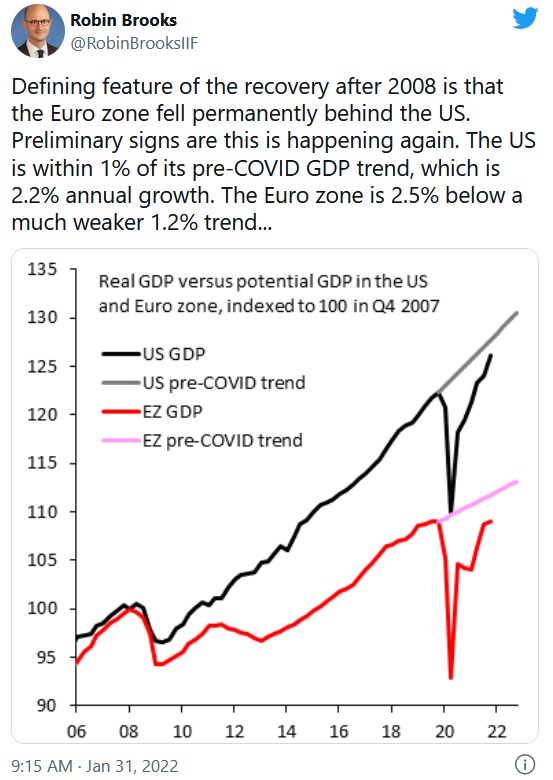


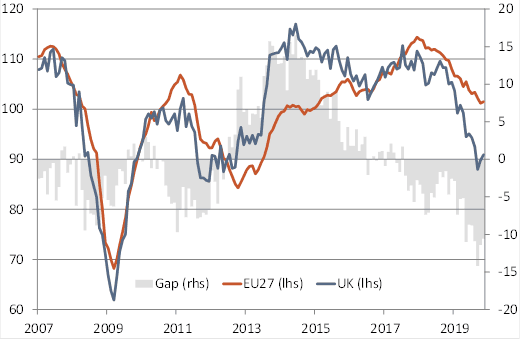
US grew from $14.8T to $25.5T
EU grew from $14.3T to $24.3T
What that means is that the prices of goods are inflated in the US compared to similar goods in the EU. That's all.
Want something interesting? Look at China who grew from $10.0T to $30.3T over the same period (!)
Sources: https://data.worldbank.org/indicator/NY.GDP.MKTP.PP.CD?locat... https://data.worldbank.org/indicator/NY.GDP.MKTP.PP.CD?locat... https://data.worldbank.org/indicator/NY.GDP.MKTP.PP.CD?locat...