Deep Throat had at least a 600x multiple (a budget of $47,000 and a box office somewhere between 30 million and 50 million). Blair witch had over a 1000x multiple, with the same 200k budget as mad Max and a box office around 200 million. Paranormal Activity also seems to be close to the 1000x mark.
I hope to see the time when it's normal to send a pair/party of multifunctional robots instead of a single rover. Imagine them repairing each other's back.
I’m not sure of the mission specifics here but my understanding is that the novelty was the landing maneuver which puts the lander within 100m of its designated target. From that POV you could definitely argue success.
Edit: It was supposed to touch down at this point, but they are pausing for 30 minutes to check the status of the craft. Doesn't look hopeful to me.
Edit 2: They now say it may take up to 2 hours to confirm the situation.
Edit 3: The craft landed successfully and is communicating properly, but the solar cell is not generating electricity, so it is being operated on low battery power. Lunar Excursion Vehicle 1 and 2 have been successfully separated.
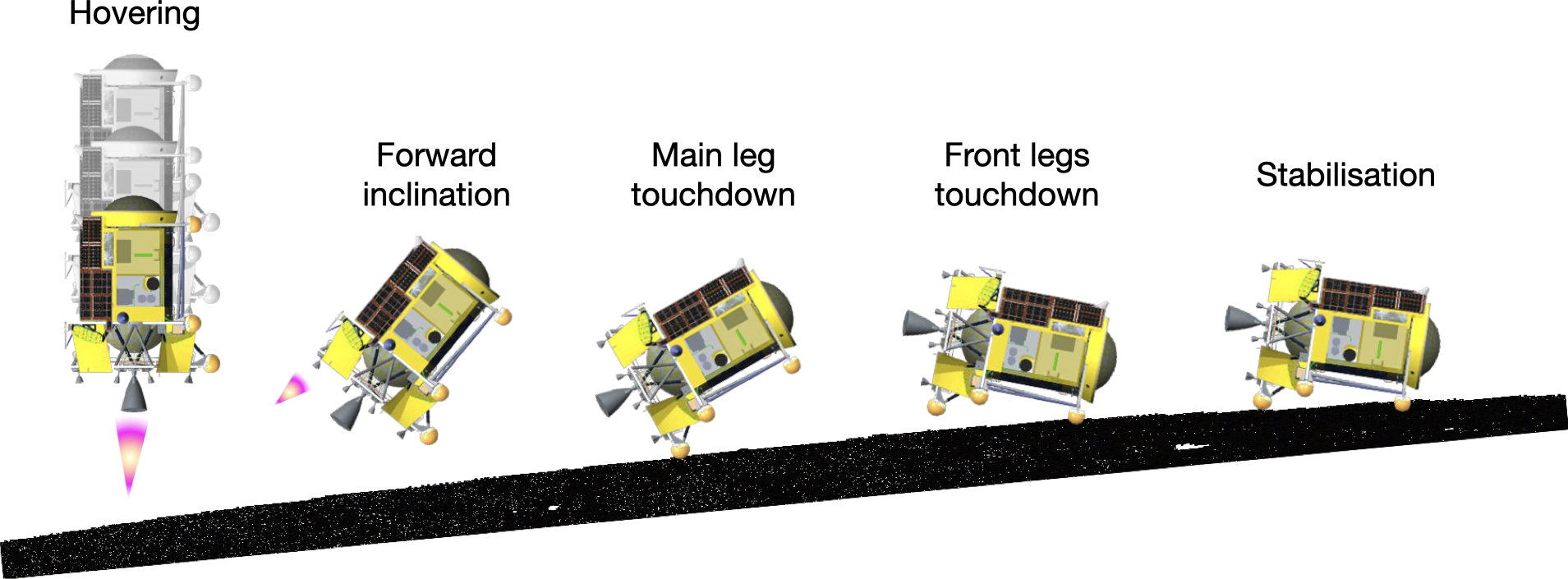
Looks like it might have rolled on landing if their telemetry representation is accurate. There were some pretty significant rotation rate readings right after the throttles shut down.
From @roelschroeven's post [1], rolling during landing was part of the design. It's possible it didn't roll as expected, though, blocking the solar panels. However the fact they were able to separate the rovers makes it seem like it could be a technical issue with the panels instead.
It really is refreshing to see the restrained satisfaction after a successful operation, compared to the jeering and cheers we’ve come to expect from the team during every SpaceX mission.
The forst model of that rover was on the ispace lander and I had the pleasure of working with the Jaxa team integrating it. Was super fun to see it rolling back and forth and taking images in the test facility.
It was the payload I was most sad to have lost on our crash.
I wish we could "cluster bomb" celestial bodies with such spheres where they have a sensor core and just roam about. Imagine deploying a body of bots via a star-link-type-launcher that just spits out a bunch of these guys as it orbits the moon - then they land and roll araound and comm back to the deployment sat and talk to eachother as the Roomba the F out of the moon and give all sensor data back to the sat launcher as it orbits...
I had similar thoughts when I saw the flea robot from Boston Dynamics.[0]
Imagine exploring mars with a combination of a dozen or so flea type robots that have solar panels on them and a robot arm for sample retrieval that can fold up into the body. They can trundle around the surface taking video and picking up samples as desired and then return to the stationary lander that they came from when needed.
The stationary lander can have all of the sample analysis machinery, seismograph, weather station, as well as a high bandwidth uplink to satellites in orbit / Earth.
Keep landing more and more of these within the the same area so that the fleas can travel between the stationary landers as they travel further and further, heck you can even form a mesh network between all of the machines on the ground, and offload a lot of heavy computational processing to the stationary landers that could be powered by an RTG.
You can risk individual fleas doing dangerous things that you otherwise wouldn't want to risk one large all in one lander on, as losing a flea only degrades a small fraction of your research and if fleas get stuck somewhere another flea can attempt to rescue it. You could even have the fleas return home to overwinter if they're not designed to withstand the winter.
There's so much versatility that you gain in a model like this with small disposable rover robots paired with massive stationary landers.
Can't believe that video is >10 years old. The 'big wheels on a pancake' form factor is easily available now in <$100 toys but inexplicably I don't see anyone using the lever+piston design for upward locomotion...although I suspect it can only pull that trick once or twice on a single charge.
I am very much with you on the 'numerous and cheap' approach to space exploration. That said, the minimal viable robot for and environment like the Moon is not an easy spec to meet, since it needs to operate in wild extremes of temperature that are hard to test for. Then again, cubesats built with very cheap hardware have proved surprisingly versatile.
> [...] environment like the Moon is not an easy spec to meet, since it needs to operate in wild extremes of temperature that are hard to test for. Then again, cubesats built with very cheap hardware have proved surprisingly versatile.
Perhaps the worst part of the lunar operating conditions is the dust. Very small particles, very abrasive, static clings to everything. Cubesats don't encounter dust.
Jiminy crickets, I am also gobsmacked for it being that long ago... I forgot about this. I wonder if the tech was "squashed" because of the implications?
If that little jumping mechanism were some small, cheap, open-sorce thing, I can only imagine it being weaponized...
However check out this cool vid on Worlds Highest Jumping Robots.
Seismic sensors would definitely benefit from this. Scientists have to get clever to estimate the direction of events when using a single sensor like on the InSight lander.
But it seems likely that it has not flipped over in the way that it was supposed to. It going below zero altitude in the end, and the "waiting for confirmation of a good landing", don't give me much hope.
Seems the last telemetry was flipped. My bet is that the last final burn before contact with the surface caused it to flip. It also looked like it carried too much velocity as the very end, again I think that's because it was doing the last hard burn in a direction not toward the surface.
Given how many failures there have been in the final process of contacting with the moon, I would be tempted to just embrace the velocity. One idea would be to use an anchor shot into the lunar surface.
Assuming it did flip over would Japan still be on the list of countries to have successfully landed? There's a big difference between what we presumably witnessed and an out of control craft smashing into the surface.
In the vein of "any landing you can walk away from", between it (a) successfully deploying the sub-rovers (though maybe that happens slightly before contact?) (b) it communicating enough post-landing telemetry that they can diagnose things, I think that should count as "successfully landing". (One of the actual mission goals was ending up on the ground within meters of where they intended, and it sounds like they nailed that too?)
If your main goal was to land and go forward with tests, but your landing started the soon to be demise of the cargo, I cant really say it's successful.
It deployed the rovers similar to how injured pilots might still exist an aircraft after a crash. If they soon die due to solar panel issues from the crash, they didn't really walk away to live another day.
https://www.theregister.com/2024/01/29/japan_lander_wakes_up... we didn't know this at posting time, but the solar panels weren't damaged, just pointed the wrong way, and when they finally got sunlight again, they were able to properly start the science mission. (Shortened, because it's not designed to survive the lunar night, but lots of neat "first time seen" data.)
Also, I thought I read that at least one of the robots actually communicates directly with earth even if the lander is toast? Honestly I'm a little surprised that our first step at investigating a moon or planet in this century isn't "deploy a microsat version of GPS + TDRSS to simplify the landers" so that the first task of every mission is just "pop a gopro" :-)
It also looked like it went below 0 altitude? I had it muted so not sure if that was expected or not, but seemed like it might have touched down too fast.
That makes sense. I was thinking that its altitude sensor might have been miscalibrated or confused, so it hadn't yet reached the ground when it thought it had.
Perhaps an improved design would not matter which orientation it came to rest in. It could extend a rod to right itself, or simply work regardless of its orientation.
It would be a fun engineering challenge to built such.
There's a fair amount of prior art in battlebots hardware, recovering from flipping over - nothing quite as weight-constrained as an actual lander, but at least there are worked examples...
Listening to the press conference, it sounds like the landing was a success but that the solar generators aren't creating any power, so they're currently on low power from the battery as they try to figure that out.
So perhaps the question is, did Shioli's parents choose this spelling because they felt Australians may more correctly pronounce her name with an L instead of an R?
I’m not sure I understand the reference, since it doesn’t mention the crater. It looks like it is just meant to be a evidence that “Shioli” can be a “Japanese female first name”. In either case, that romanization is uncommon, so the question stands.
I wondered about pronunciation by foreigners being a motivation, but I would still expect an incorrect pronunciation like “shy-oh-ly”.
Considering this is an ISAS project I wouldn't be surprised there were an eroge character named and spelled conspicuously similar to that.
That naming was briefly mentioned in the press conference, and the official reasoning told was it was so named "in the hope this landing will be a bookmark(shiori) in the long history of human aspirations towards the Moon", :shrug:.
There is no evidence that it was named after her in the referenced Deadpool article, and I would expect the “Origin” field to mention it if it was the case. Your conclusion doesn’t seem plausible to me.
There is livestream of the signal being picked up at Bochum.
They say it landed safely (See comments on the right)
"Live spectrum view and waterfall from the X-Band or S-Band receiver at the 20m radio telescope at Bochum Observatory / Germany" -https://www.youtube.com/watch?v=2pPBCIpVGsM
Space really has a PR issue, waiting around for a press conference and they really need live video from the moon, it's hard but important.
Live TV from Apollo 11 had a huge cultural impact. People who were born before the Wright Brothers flier watched the moon landing on live TV. They had an incredible sense of Progress that we seem to have mostly lost.
Hmmm ... the CBS Evening News channel on YouTube said it was a private company, another subthread here refers to one. I wonder what he arrangement is. JAXA subcontracted it?
>JAXA is the Japanese national air and space agency. Through the merger of three previously independent organizations, JAXA was formed on 1 October 2003.


https://www.newscientist.com/article/2413336-japans-slim-spa...
https://spacenews.com/japan-makes-history-with-tense-success...
https://www.bbc.com/news/live/science-environment-68019846
(these were all submitted later but there weren't any comments yet to merge)