It was truly jaw dropping firing up quake 1 for the first time on 3dfx voodoo1. Double the resolution of software and super smooth framerate, and much better quality texture mapping too. I recall tweaking some setting (gl_flashblend?) so that I could see pretty glowing orbs around my rockets (and strategically, also everybody else's rockets).
It's hard to convey just how revolutionary the original voodoo cards were. There aren't many times in my life where there was a clear line of before and after, but this was one of those times.
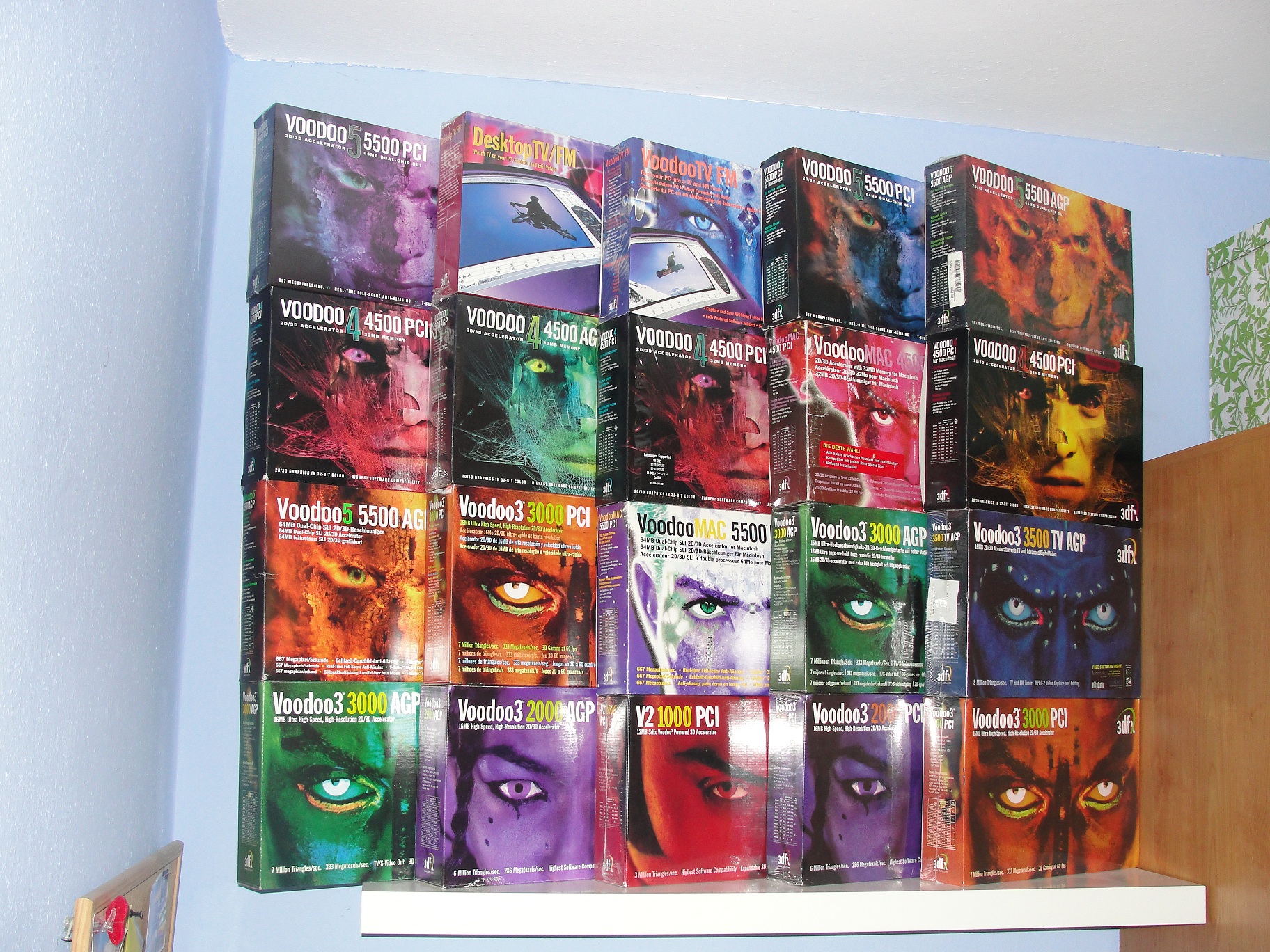
They also had the most recognizable unified box art style from all HW makers[1]. When you saw those eyes staring into your soul off the shelves, you knew it was a 3dfx GPU. They also had the best ads. [2] HW vendors today don't have the balls anymore to use designs like that, it's all flat sterile corporate nonsense.
Unless I'm mistaken, those cards were all produced by 3dfx after their acquisition of STB. Regardless, that box art blew my 14 year old mind back in the day.
I think mine went into a computer that we donated to a school, or something. Around 2002 or 2003, my dad and I put together a bunch of working systems out of spare parts and donated them.
Mine was the PCI version of the card. Crazy looking on Ebay how much even the bare card goes for now, let alone when someone has the full boxed set.
I wiped my drive a few times before realizing dropbox didn't back my wallet up. I shrugged it off losing 30 bitcoins worth maybe at best 3 cents each at the time. Hindsight is 20/20 I suppose.
Still blows my mind that it was just a flash in the pan. At the time it felt that 3dfx was certainly going to be a dominant force in computing for years. And although they lingered a bit, the whole event was barely over 2 years.
I think everyone understood that having it be 3D-only (and requiring a separate graphics card to do normal 2D desktop graphics) was a half-solution, and 3DFX's long term success would depend on their ability to provide a full 2D/3D solution before existing competitors like NVIDIA, ATI, and Matrox could catch up with their own 3D accelerators.
I remember reading a historical piece where the voodoos success was partially luck. At the time the first generation cards were being developed edo ram was super expensive so most competitive designs were hamstrung trying to do things with very little ram. By luck edo ram prices crashed right as they released making them far more affordable to manufacture than 3dfx could have reasonably expected. That gave them an early and massive lead with their initial design.
That took a lot longer really as well... I remember seeing SATA SSDs around 2009, paying a massive amount for my 64gb Intel drive (that ate itself just over a year later)... I hated moving/symlinking so much... but, fortunately by the time it died, I could go to 256gb or 512gb (don't quite remember which) for not too much more.
Even then, I was still seeing most Desktops sold with spinning rust for several years later.
I was the unfortunate owner of an S3 ViRGE card at the time - the (in)famous "3D decelerator". I managed to get Quake running on it, and it looked nice, but was slower than with software rendering...
I had an S3 ViRGE too. It really was a decelerator, and the number of games that actually supported it was minuscule. I managed to run GLQuake, but without any textures - just shades of gray - and even that ran at most a couple of frames per second.
But there was another game - Terminal Velocity - that actually looked a lot better with hardware rendering, although it was still slower than software rendering. So, I would run it with hardware rendering to enjoy flying and then restart the game with software rendering to actually fight the enemies. :)
Same here. I can still vividly remember the experience of loading in with a voodoo2 for the first time. It was night and day -- mind completely blown. The late `90s really established a new version of the gamer; consoles were fun, but computer gaming was a different world. It made me a junky for reading about hardware, overclocking and gaming.
Replaying Heretic 2 back in 1998 with my first Voodoo (banshee) was a borderline otherwordly experience, compared to my first playthrough of the game using software rendering. Nothing has blown my mind the same way since.
I have had three experiences like this in my life:
  1. PC Speaker -> Sound Blaster: Most games that I had were instantly upgraded

  2. Doom: my first "real" fluid 3D experience, with stairs, etc, compared to maze-like maps in Wolfenstein

  3. Software Rendering -> 3dfx (Canopus Pure3D): Transparent water surfaces in Quake (if you re-vis'd the maps), smooth and fluid visuals, it was amazing.
The closest thing to this, in modern gaming, has been the boss fights in Elden Ring: https://i.imgur.com/gzLvsLw.mp4 -- visually, they are quite epic.
Debatable. I always preferred the crisp look of the software renderer to the washed out GLQuake. Same with Quake 2. I think it because textures back then were too low resolution so filtering just makes them look muddy.
It’s also because the VGA signal quality from the 3dfx Voodoo wasn’t very good.
It didn’t have a traditional 2D graphics core at all, so it needed another graphics card for rendering the desktop (any non-accelerated apps really), and this was connected to the Voodoo using VGA passthrough. There was a noticeable image quality loss from this arrangement.
A Matrox card would give you crisp VGA with nice saturation, but the 3D acceleration was nearly worthless. Choices…
I really disagree. There were some nice Matrox cards. They weren't as good at 3d as 3DFX but for the time they really improved gaming. I developed Battlezone on G200. In those days we tried to have everyone have a different graphics card because the companies would just give them to us and we wanted to work with every card.
Matrox had great hardware, but the software drivers took too long to catch up. I was on the OpenGL team and my life's mission was to get Quake running as fast as the G200 and G400 was capable of. We finally caught up and got parity with Nvidia's TNT2, and then bam, they released the GeForce 256 series, and it was curtains for Matrox because their next gen hardware wasn't ready yet.
I agree that the washed-out textures haven’t aged well.
But at the time, not having pixelated textures was the first thing people looked at when judging graphics quality. I remember that being a HUGE selling point of the N64 and something that made the console look almost a generation ahead of the PlayStation and Sega Saturn to kids back then.
Today, I think I prefer the PSX look, thoug. Maybe with Z-buffer correction to avoid the warped textures of the PlayStation.
Might have also been one of those things that looked better on the 14-15" CRTs of the time vs crisp high-res flat panels of today. They were blurry enough that 640x480 was "high resolution" (I remember not being able to easily see the pixels at 800x600 on a 14" CRT unless I came super close to the monitor).
Even today I think a lot of Doom clones look better (or more nostalgic) with software rendering and texture mapping rather than OpenGL. There's an intensity of saturation to the colors that's lost. Fireblu is never quite so eye burning as when it's in software.
You can 'fix' the texture filtering to nearest neighbour in hl by adding the following to userconfig.cfg (should be in a directory called 'valve' in the game's root directory):
gl_texturemode GL_NEAREST_MIPMAP_LINEAR
gl_ansio "0"
gl_round_down "0"
Or just entering those lines in the consoe, preceded by 'set'
I came here to comment similarly, the lower pixelated software rendered Quake seems to work well with the textures. They have a bumpmappy fuzzy feel that gets lost with the sharp corners everything is super flat texture mapped and filtered version that one got from the 3d accelerators of the time. I guess my brain just adds context to the low res images.
Before unreal, I had a s3-virge for 2d and a powerVR 3d accelerator pair, and I was always flipping between software, virge and powerVR depending on game. Which at the time were largely hexen/heretic. The powerVR was higher resolution and clean/sterile but never seemed like a lot better experience.
But then there was unreal, the first game I think was absolutely better on an accelerator (voodoo2 in my case). Its also pretty much the last of the serious software renderers and outside of the voodoo's definitely did a better job with software lighting /texture mapping/etc than any of the previous (affordable) accelerators. Which is why I ended up finally replacing the powerVR with the voodoo2. The results were 'unreal'. Some of that might just be bias, I played insane amounts of doom/etc but never really got into quake. Quake just seemed like doom rehashed to me, so I was off playing warcraft/diablo/hexen/etc.
And frankly, outside of FEAR, I stopped playing 1st person shooter games for 20 years, the graphics improvements were so incremental, I just kept seeing flat low polygon models everywhere. And I don't think that looks good. Even after all the tessellation/bump mapping/endless tricks I kept seeing frames where I could play "count how many polygons are onscreen right now" games. Its gotten better the past few years, particularly some of the lighting, at least the screenshots/cut scenes are no longer obviously not in game rendering. The UE5 demo is slowly becoming reality in actual games, so maybe its time to revisit a few of them.
Always thought the original software renderer looked much better. It didn’t have the bilinear filtering, so the textures didn’t look all smooth and ‘washed out’, which suited the environment more imho
I can't speak for the original GLQuake on 3dfx hardware, but on OpenGL-compatible Quake engines (which include modern Quake source ports such as Quakespasm, Ironwail, and vkQuake), bilinear texture filtering is an option that can be turned off.
I play on vkQuake with nearest-neighbor texture filtering, square particles, and the "classic" water warping effect and lighting effects, alongside 8x MSAA, 16x anisotropic filtering, high-resolution widescreen, etc. This keeps the art style consistent with the look of the original Quake, while still allowing for the benefits of hardware 3D acceleration.
For what it's worth, the modern source port for Descent (DXX-Rebirth) makes bilinear filtering optional, too, while using OpenGL and allowing MSAA and stuff. I played through the first two games some time ago and I also found the bilinear filtered textures worse-looking than the blocky ones.
I'd be interested in a RTX-enhanced software renderer. Ie replace the baked lighting with the GI raytracing, but otherwise keep the rest of the software renderer. Have a feeling that could be an awesome blend.
Would be a bit challenging with the palette but should be doable.
Yeah that's what I was thinking. Like do a RT-only pass doing lighting (no textures), then do the software pass using the RT-lighting rather than baked lightmaps.
Latency would be slightly higher but I guess one could implement the important parts[1] of the software renderer on the GPU.
In terms of pixels, it was 4x the resolution. And for fun, one of the window textures (visible in the difficulty choice lobby IIRC) was implemented as a mirror in glquake - IIRC John Carmack said it was so easy to do in OpenGL he did it as a kind of test.
I dreamt about having the vodoo but i could not afford it. Went with a rendition verite based one. It was underpowered compared to the vodoo but I really consider it the first real GPU as it was a RISC processor.
For me it was Carmageddon. I bought it later on an ipad and it may have just been rose tinted glasses of being completely blown away back in the day but the ipad version never seems quite as crisp...