The average global citizen also isn't paying American costs of living. My cousins in Asia are earning easily 10x less than I am in real nominal currency, but their cost of living is commensurately less.
Measures of wealth are just numbers until put in context of local costs of living.
Which addresses the reply to your post: $100K is wealthy in parts of the country, it's not wealthy in others. Getting paid $100K in small-town Idaho is a whole different ball game than getting paid $100K in SF.
The trick is that there are a lot more $100K jobs in one place than the other. What PhasmaFelis insists on calling "living beyond your means" is often nothing more than people looking for work.
Agreed. Title is bullshit, and the article does nothing to change my mind: if you insist on living beyond your means, then no amount of income will seem like enough. $100,000/year is not a free license to move to the trendiest neighborhoods in the most expensive cities and start collecting yachts, but it's still rich by any reasonable human standards.
Not it sure as hell does not mean one is "rich." It is, at best, an indicator of marginal affluence. It certainly is stretching the bounds of credulity to call it "merely" middle-class, though, and forget calling it "poor."
"Rich" means more than having a relatively high income. It means having the means to obtain in relative short order, or having already obtained, relative financial independence. An income of $100,000 doesn't qualify in most places. Such a person would be required to find some income if he loses his current source, and he would almost certainly suffer financially and take many hits to his credit during a period without income. This person isn't "rich" until he's amassed enough savings that he can weather such a period without significant risk to his finances or credit, which will take literally decades in most cases.
What if your job is in Manhattan where that means you are making negative income vs. your rent? And a good meal is ten times more than a beef soup shop in Taiwan? Or spending 2 hours every morning commuting into the city and back out on a bus to somewhere you can afford on $50k/yr? Is that still rich?
To handle questions like "And a good meal is ten times more than a beef soup shop in Taiwan?" we can use "Purchasing Power Parity". And adjusting for PPP we still see that an income of $100k is in the top few percent worldwide: http://jefftk.com/world-income-distribution.png
I've lived / worked in midtown Manhattan on both $35k/year and $90k/year (and between) within the past 3 years, and they are both doable. At 30k, I wasn't rich for sure, but I wasn't poor either. Still going out to eat mostly, and not missing out much with friends.
As it got closer to 90k, things got easier for sure. I'm not married, so no dual income, but my total monthly expenses come out around 2k (rent, good food (never eating at home), utilities, misc stuff) which leaves about 3k/mo left over. I would consider this materially wealthy, at least.
> I'm not married
So having roommates was an option. And you didn't need another bedroom for the kids. Your housing costs were far below those of an average family. Which is sort of the point of all the comments about dual incomes being required.
But it's just so hard affording a downtown condo while putting my kids through private school! I'm obviously living paycheck to paycheck exactly like the vast numbers of americans earning 2/3 or less of a living wage with no medical coverage, no paid time off, and spiraling debt!
Don't forget to take into account the massive amount of student debt people have now, and also the vast cost of living in larger tech centric cities such as SF and NYC. I'm not talking fancy apartments either, I'm talking regular standard 1 br apartments.
Just because someones income is a certain amount on paper it doesn't take into account other financial responsibilities that lower the amount you have leftover at the end of the month.


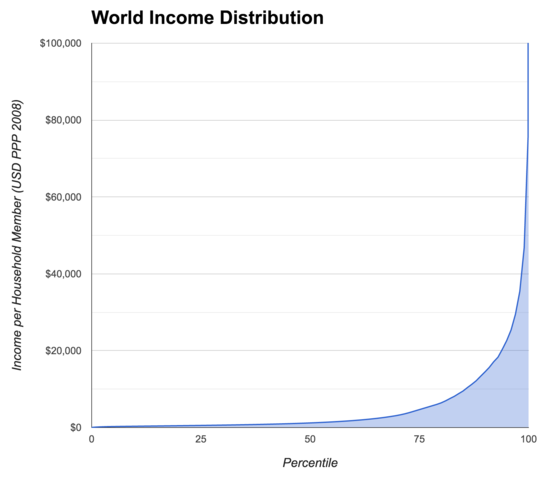
Median household income in the US is about $50k/yr. The average global income is about $10k/yr.